



What is the largest threat to the honeybee population? One might guess global warming, or pesticides, or disease. But there is a rapidly growing threat that is under the radar for most people: Other bees – specifically, the yellow-legged hornet.
These large hornets can wipe out an entire honeybee colony over time. Honeybees are vital to our economy and ecosystem in a variety of ways. They are among the most effective pollinators on earth, and up to a third of the food we eat depends on pollinators like honeybees. They transfer pollen between flowers, enabling them to reproduce.
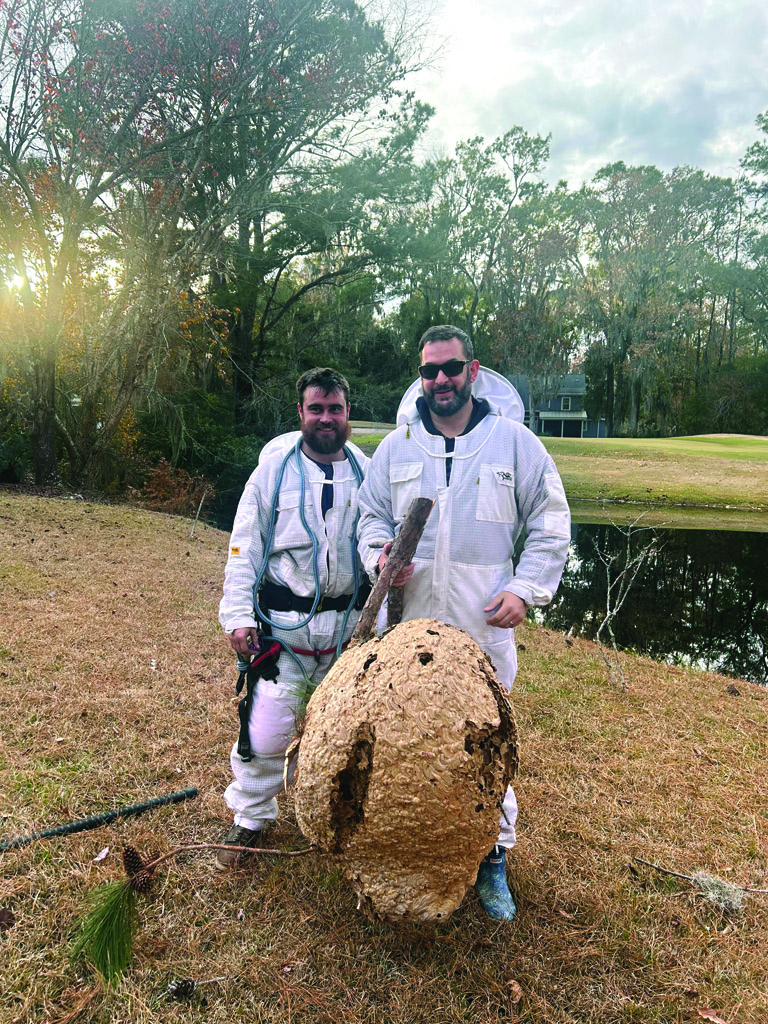
Secondary nests can grow to an extremely large size. Only trained pest control professionals have the expertise to properly eliminate nests at this stage of maturity.
Honeybees are critical for crops. Without them, many fruits, vegetables, and nuts would become scarce and dramatically more expensive. In general, honeybees promote plant diversity, support entire food chains for birds, insects, and mammals, and help stabilize soils and improve environmental resilience.
Since honeybees are so important for ecosystem and economic health, and their diminished population could have devastating effects, somebody had better start paying attention to the yellow-legged hornet threat.
Fortunately, this growing threat is on the radar of pest professionals like Hilton Head Exterminators and the Clemson University Apiary Inspection Program.

Identifying and eliminating nests in the embryo nest stage is the best prevention. Homeowners should report any nests immediately.
When, where, and how did the yellow-legged hornet become a problem in our area? They are believed to have come from China through shipping containers. This is only a recent problem in our region, being first discovered in the Savannah area in 2023.
The problem has proliferated rapidly in just a few short years. In fact, according to Brad Cavin, coordinator of the Apiary Inspection Program at Clemson, the numbers are alarming. “In 2024, we found 16 nests. In 2025, we eliminated 137 nests,” he reported. “In 2026, we have already found 41 nests, so we’re on pace to hit over 160 nests this year.”
Just as aggressive as the yellow-legged hornet is the effort to control and eliminate them. Cavin reported that his team has 2,700 traps in the Lowcountry to trap queens and prevent future nest expansion. Each trap is inspected weekly to help turn the tide on the increasing nest count each year.
However, the professionals can’t win the battle alone. They call on the public to watch for, discover, and report any nest activities. The best defense is a good offense. That is, an informed awareness of what to look for and to whom to report possible nests.
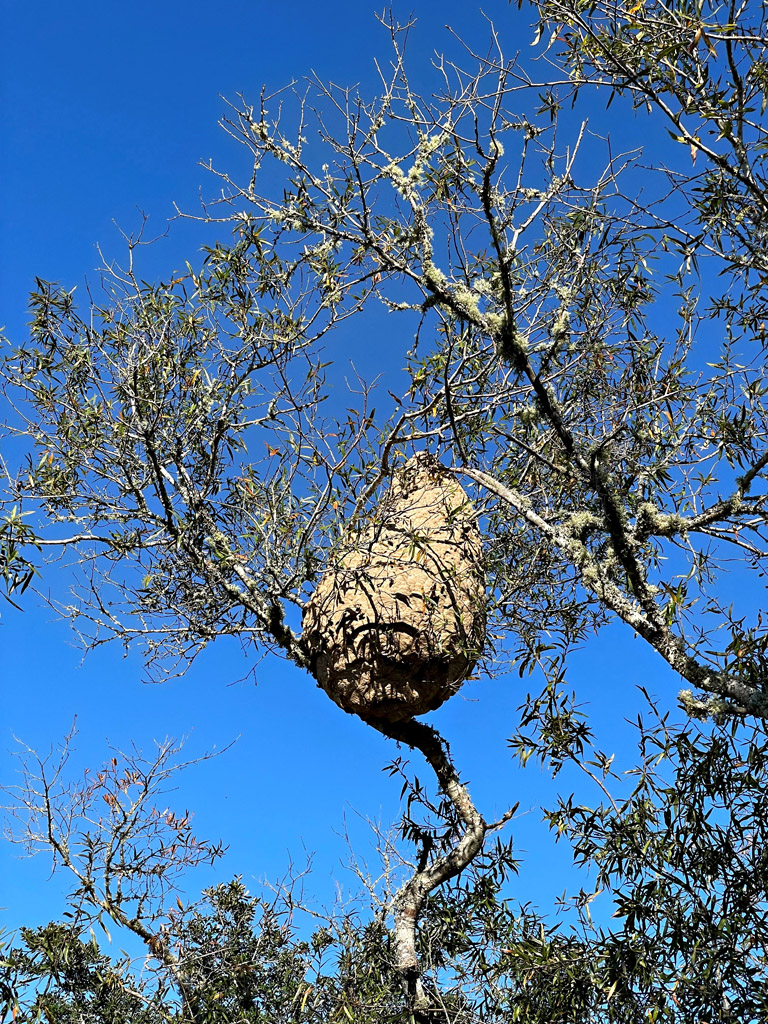
Yellow-legged hornet nests are most often discovered high above the ground near the tops of trees. The public should report any sightings so pest control professionals can destroy the nest.
The initial stage is the embryo nest, a small, golf ball-size nest that houses the queen. As the population increases, the queen and her expanding population migrate to a new home, called a primary nest. This larger nest provides room for dramatic population expansion. The final phase is the secondary nest, a huge orb, usually seen very high up in the top of a tree. This huge nest can house thousands of yellow-legged hornets. The entire process can take only a few months to go from embryo to secondary nest.
Cavin and his team from Clemson University have resources that can equip the public to assist them in finding nests, hopefully before they reach maturity. On the Clemson University website (clemson.edu), one can search “The Hornet Herald,” which includes links to a number of tools and techniques that can geometrically expand the ability to discover nests.

The eradication of nests, of any size, is best accomplished by a pest control professional. This can prevent painful bee stings but also ensures that the queen is eliminated, which is key to preventing any chance for expansion.
Brian DeChirico, general manager at Hilton Head Exterminators, said they have been called to eliminate more than 100 nests. This usually involves the use of a man lift that can take the technician to the top of a tree that is home for the secondary stage nest. The hole in the nest is plugged and a plastic bag is put around the nest. After cutting the nest from the tree the bag is treated and the entire population of the nest is eliminated.
Devin said that the elimination procedure would be much easier if nests were discovered prior to the mature stage. That is why the public has been called on to help identify nests and given tools to make that procedure as simple as possible.