

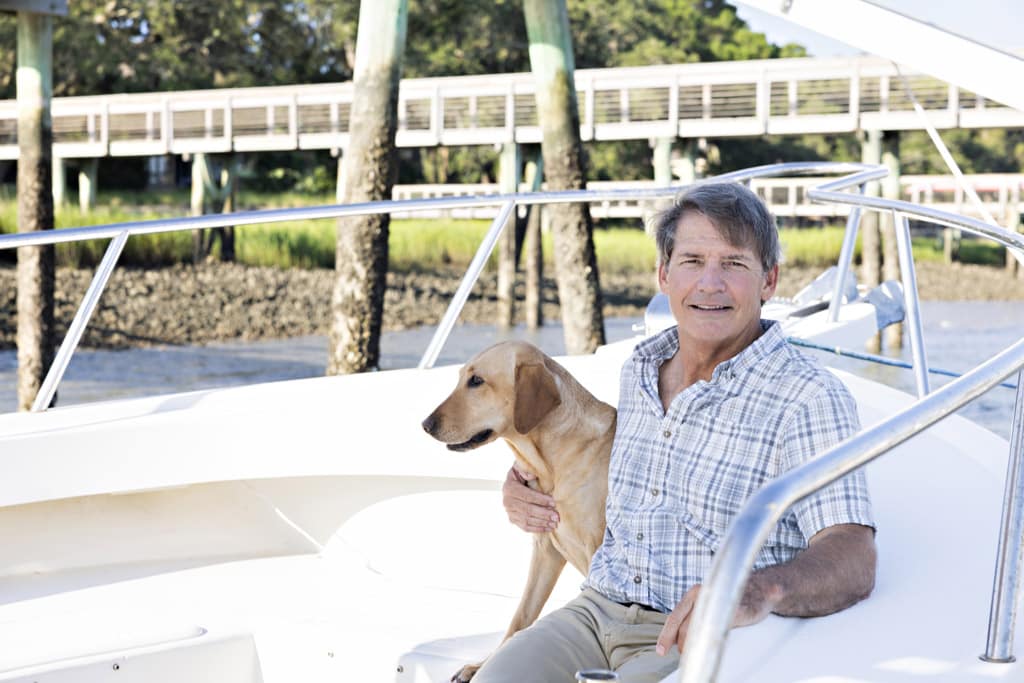

By the time Lee Edwards was old enough to understand what his parents did for a living, Hilton Head Island was still discovering what it would become.
When his parents, Berry and Ruthie, purchased a small landscape company called The Greenery in 1973, Lee was only four years old. The island’s now-iconic neighborhoods were still taking shape, Bluffton was little more than a sleepy crossroads, and much of the Lowcountry’s explosive growth lay decades in the future. As other children spent summers at the beach, Edwards spent his time watching crews transform bare stretches of sand and scrub into lush entrances, neighborhoods, and commercial properties that would become familiar landmarks across the region.
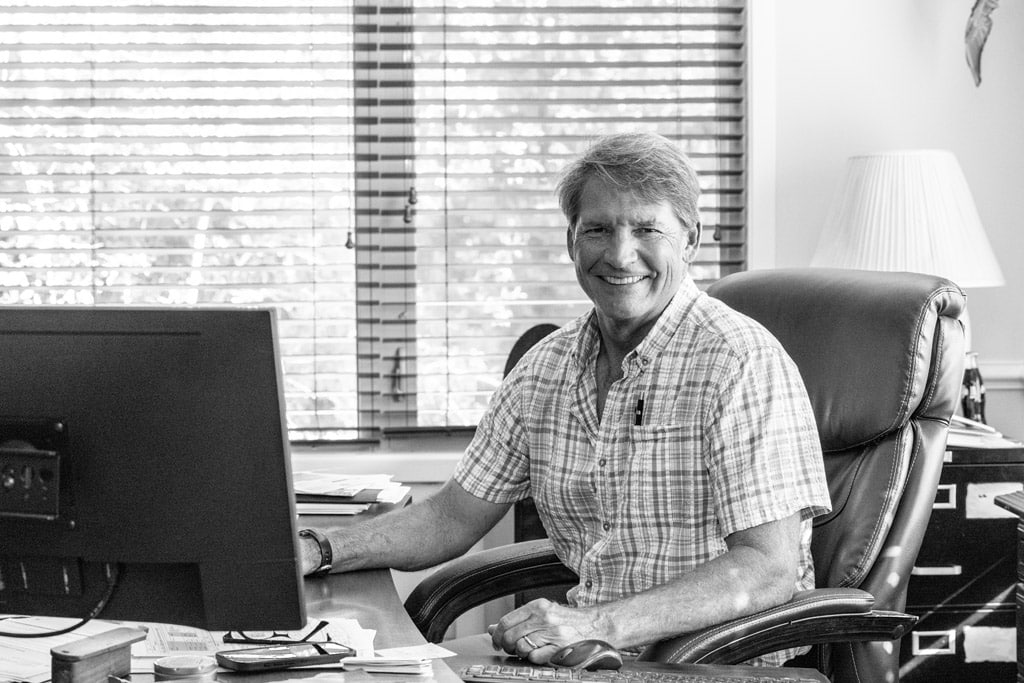
He didn’t realize it then, but he was receiving an education that couldn’t be taught in a classroom. That upbringing instilled an appreciation not only for hard work, but for the patience required to build something lasting. Landscapes don’t mature overnight, and neither do successful businesses. Both require vision, consistent care, and a willingness to think years – even decades – ahead.
Today, as president and CEO of The Greenery, Edwards leads one of the Southeast’s premier commercial landscape companies, with operations spanning South Carolina, Georgia, and Florida. Yet despite overseeing a company far larger and more sophisticated than the one his parents purchased more than 50 years ago, his philosophy remains remarkably grounded.
Success, he believes, has never been about growing the biggest company. It’s about building the right one.
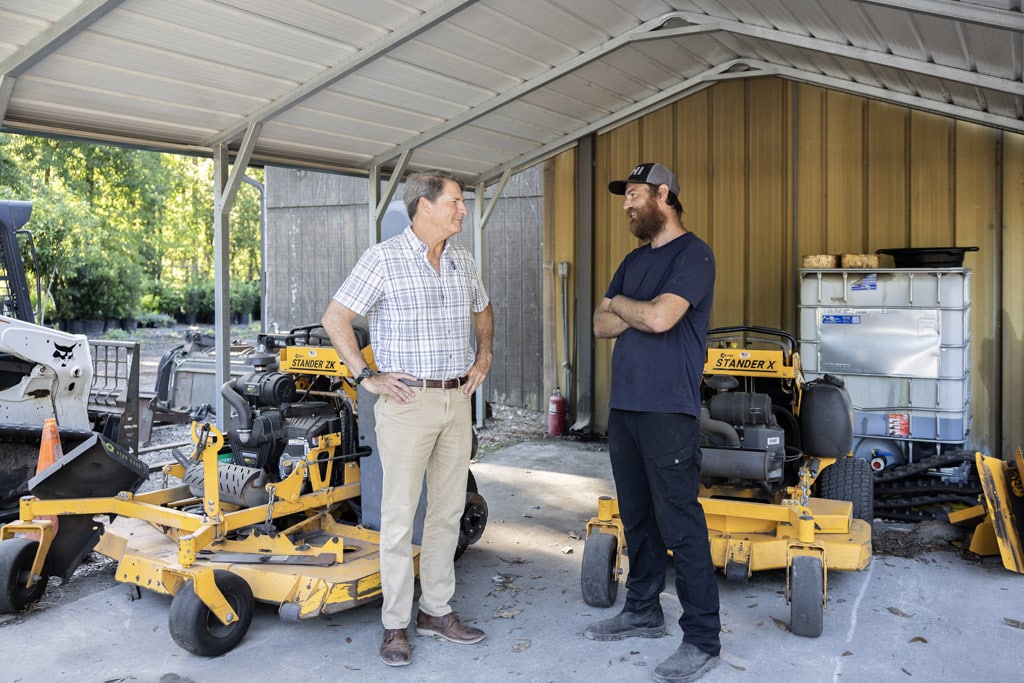
Lee Edwards chats with Evan Hurley, fleet shop manager at The Greenery’s Arrow Road location.
Finding His Own Path
For many second-generation business owners, joining the family company feels inevitable. For Edwards, it wasn’t. In fact, after graduating from Tulane University, he intentionally set out to do almost anything except return home.
“My parents never pressured me to come into the business,” he said. “They basically told me, ‘You’re off the payroll now. You can always come home and sleep in your old bed, but don’t ask us for money.’”
He laughs at the memory now, but the lesson proved invaluable. Instead of stepping directly into a leadership role, Edwards spent several years discovering who he was outside the family business.
He lived in the Virgin Islands, supporting himself by bartending and working construction while living aboard an aging sailboat. After selling the boat, he traveled throughout Central America for nearly a year, teaching English and immersing himself in different cultures. Those experiences taught lessons no business textbook could provide.
Travel demanded resourcefulness. Construction reinforced the value of physical labor. Living on limited means cultivated humility. Learning Spanish allowed him to communicate fluently with workers from diverse backgrounds – something that would later become one of his greatest professional assets. Looking back, Edwards believes leaving Hilton Head ultimately made him a better leader when he returned.
“I was thinking I would go to business school,” he said. “That was the plan.”
Life, however, had other ideas.
The Turning Point
Friends eventually persuaded Edwards to spend a winter in Aspen, Colorado. One season became another, and before long he accepted a position with a local landscape company. It seemed like a temporary job. Instead, it became the turning point of his career.
Because he already knew how to operate equipment and communicate with Spanish-speaking crews, Edwards quickly found himself taking on increasing responsibility.
“About halfway through the summer, I realized I was actually enjoying it,” he said. “I thought, maybe I’m pretty good at this.”
For the first time, landscaping wasn’t simply the family business he had grown up around. It became a profession filled with strategy, logistics, leadership, and endless opportunities to solve problems. Rather than pursuing graduate school, Edwards picked up the phone and called his father.
“I told him I’d like to think about coming back and working at The Greenery. And he said, ‘Great! We could really use you.’”
Even then, his father had one more lesson waiting.
Learning Before Leading
Instead of bringing his son directly into the company, Edwards’ father encouraged him to spend time with one of the nation’s most respected landscape firms in Maryland. It proved to be one of the most influential experiences of his career.
Until then, Edwards had worked for The Greenery and one relatively small company in Colorado. The Maryland operation was entirely different: Multiple branches. Dedicated human resources. Formal onboarding programs. Structured management systems. Clear opportunities for advancement.
“It opened my eyes to what The Greenery could become,” Edwards said.
Importantly, it challenged him to think differently. Rather than seeing landscaping as simply completing projects, he began seeing the importance of building an organization capable of sustaining growth. “I realized we could promote people from within,” he said. “We could train people better. We could build management systems that helped people succeed.”
He wasn’t interested in adding bureaucracy. He wanted to create a company where people could build careers. That distinction would become one of the defining characteristics of his leadership.
Edwards returned to Hilton Head in the fall of 1994. The timing could not have been better. Sun City Hilton Head was beginning construction. Bluffton was on the verge of unprecedented growth. Highway 278 still consisted of just two lanes cutting through what many people viewed as little more than open countryside. While others saw undeveloped land, the Edwards saw opportunity.
Recognizing that the future lay west of Hilton Head Island, they relocated The Greenery’s construction division to their Bluffton maintenance shop and began expanding into new markets, including Beaufort, Savannah, and eventually Charleston.
“The growth was happening,” he said. “We just needed to be positioned to take advantage of it.”
Building More Than Landscapes
Commercial landscaping is often misunderstood. To many people, it conjures images of lawnmowers, leaf blowers, and neatly trimmed hedges. Edwards smiles at the misconception.
“The reality is much more complex,” he said.
Today’s commercial landscape company functions as part construction firm, part horticultural expert, part environmental steward, and part logistics operation. Projects frequently involve sophisticated irrigation systems, erosion control, drainage planning, tree preservation, seasonal color design, water management, lighting, hardscapes, and long-term maintenance strategies that protect millions of dollars in property investments.
Large commercial communities, resorts, municipalities, and homeowners’ associations depend on landscapes that remain healthy year-round despite extreme weather, changing seasons, and heavy public use. Achieving that requires far more than routine maintenance. “It certainly isn’t just mowing grass,” Edwards said. “There are a lot of moving pieces.”
That complexity is precisely what appealed to him. Every project presents new challenges and requires different solutions. And every successful installation reflects months – sometimes years – of planning and coordination.
Raising the Standard
One of Berry Edwards’ earliest priorities was elevating The Greenery’s level of professionalism. He believed clients deserved more than basic maintenance. At a time when many landscape companies embraced what Lee jokingly calls the “mow, blow, and go” approach, The Greenery focused on preventative care, horticultural expertise, and long-term planning.
Instead of applying fertilizer once or twice a year, the company developed comprehensive nutrient programs. Instead of waiting for irrigation systems to fail, they embraced emerging technologies that allowed remote monitoring and improved water conservation.
Certified horticulturists joined the team. Communication became as important as craftsmanship. “We believed there was a better way,” Edwards said.
Clients noticed. Developers noticed. Before long, projects grew larger, more technically demanding, and increasingly visible throughout the Southeast. The Greenery wasn’t simply maintaining landscapes anymore. It was redefining expectations for what commercial landscaping could be.
One project changed the trajectory of the company.
After completing an elaborate entrance for a major Charleston development – complete with cascading waterfalls, multi-tiered fountains, mature trees and extensive masonry – The Greenery suddenly found itself fielding calls from developers across the region.
Instead of trying to manage those opportunities from Hilton Head, Edwards made another bold decision: He moved. In 1999, he relocated to Charleston to establish The Greenery of Charleston, taking just one employee with him and starting almost from scratch.
“It was intimidating,” he said. “We had one big job lined up, and after that we just kept growing.”
Charleston was entering a period of extraordinary growth, and the Edwards believed there was room in the market for a company committed to a higher level of service and professionalism. The gamble paid off. Within a few years, The Greenery had become the dominant commercial landscape company in the Charleston market.
“We never really slowed down, and we weren’t necessarily doing something nobody else could do,” he said. “We were just doing it at a consistently higher level.”
That philosophy extended well beyond beautiful landscapes. It meant communicating proactively with clients, embracing emerging technologies, investing in employee training, and never becoming complacent simply because of reputation.
“Yesterday’s success never guarantees tomorrow’s,” he said. “You have to keep getting better.”
Growing Leaders
As The Greenery expanded, Edwards discovered that one of leadership’s greatest challenges had little to do with landscaping. It had everything to do with letting go.
Like many entrepreneurs, he initially believed that the best way to ensure quality was to remain personally involved in nearly every decision. But as the company continued growing, that approach became unsustainable. “The bigger you get, the more you have to trust other people,” he said.
Today, Edwards speaks about leadership less in terms of authority than responsibility. His role is no longer to make every decision. His responsibility is to build a team capable of making excellent decisions without him. That begins with hiring exceptional people.
“I’ve always tried to surround myself with really smart people,” he said. “People I trust. People who work as hard as I do.”
It’s advice he readily shares with young entrepreneurs. Too often, he believes, business owners feel they must prove they’re the smartest person in the room. Edwards sees it differently. “The best leaders hire people who know more than they do in certain areas,” he said. “The best lesson I learned from my father was, hire great people, give them the tools and support they need, and get out of the way.”
Whether it’s finance, horticulture, operations, technology, or human resources, he believes successful organizations thrive when leaders empower specialists instead of trying to become experts in everything themselves. That willingness to trust others has created opportunities for employees to grow into leadership positions while strengthening the company as a whole. “I don’t think one person builds a great business,” he said. “A great team builds a great business.”
A Culture Worth Investing In
While The Greenery’s landscapes might be its most visible product, Edwards believes the company’s greatest asset has always been its people.
Over the years, he has watched employees build careers – not just jobs – within the organization. Many have spent decades with the company, growing alongside it as operations expanded into new markets and new specialties. That commitment to employees has shaped many of the company’s business decisions.
When Berry Edwards decided to retire, The Greenery became an Employee Stock Ownership Plan (ESOP), allowing employees to share in the company’s success through ownership. As the organization continued growing, however, leadership recognized that the structure no longer reflected the realities of a much larger company. Over time, the ESOP had become increasingly difficult for newer employees to benefit from in the same way long-tenured team members had.
Again, Edwards and his leadership team chose to evolve. The company transitioned to a different ownership structure with a performance-based incentive bonus program designed to reward employees more equitably while directly connecting individual success with company performance.
“When the company does well, everybody does well,” Edwards said.
The program has proven enormously successful – not only because it rewards performance, but because it reinforces something Edwards has always believed: People are more invested when they understand that their work genuinely contributes to a shared outcome.
“It creates ownership in a different way,” he said. “Everyone understands they’re helping move the company forward.”
That mindset has helped cultivate a culture where employees celebrate one another’s successes instead of competing against one another. It also reinforces another lesson Edwards has learned over three decades of leadership: Business is ultimately a team sport.
Despite decades of success, Edwards is remarkably reluctant to describe himself as having all the answers. If anything, experience has taught him the opposite. “The longer I’ve been doing this, the more I realize how much there still is to learn,” he said.
Markets change. Technology evolves. Environmental regulations shift. Customer expectations continue rising. The companies that survive, he believes, are the ones willing to adapt. That willingness to learn has remained a hallmark of his career since the day he stepped inside that Maryland landscape company as a young intern.
He still looks outside his own organization for ideas. He still believes innovation matters. And he still encourages his leadership team to challenge long-standing assumptions whenever better solutions emerge. Growth, in his view, begins the moment leaders admit they don’t know everything.
Advice for the Next Generation
Ask Edwards what advice he would give someone hoping to build a successful business, and his answer has little to do with landscaping. Instead, he talks about character, relationships, humility, and patience. “Surround yourself with great people,” he said. “Hire people you trust. Work hard enough to earn their respect. Then give them room to succeed.”
He also cautions young entrepreneurs against chasing quick wins. The most successful companies aren’t built in months, he cautioned. They’re built over decades through consistency, integrity, and countless small decisions that rarely make headlines. “Reputation matters,” he said. “You earn it every day.”
He encourages young business owners to remain curious, to listen more than they speak, and to recognize that leadership isn’t about having all the answers. It’s about creating an environment where other people can do their best work.
A Legacy Still Growing
Today, it would be difficult to drive very far across the Lowcountry without encountering a property shaped by The Greenery. From the entrances welcoming visitors into master-planned communities to commercial campuses, resorts, municipalities, and neighborhood landscapes, the company’s work has become woven into the fabric of the region Edwards has called home since childhood.
Yet ask him what makes him most proud, and he talks about people. He talks about the managers who began in entry-level positions and now lead divisions. The immigrant who began pushing a mower and didn’t speak english and is now a manager living ‘the American Dream’- a solid career, home ownership, and putting his kids through college. The employees who have spent decades building careers with the company, and the clients who have entrusted The Greenery with their properties year after year. Those relationships, he believes, represent the company’s greatest accomplishment.
Landscapes change with the seasons, businesses evolve, and communities continue to grow. But trust – earned through decades of keeping promises – endures. Perhaps that’s fitting for someone whose life has been spent helping things grow.
After all, beautiful landscapes are never created overnight. They flourish because someone plants a vision, nurtures it with patience, and invests in it long after the initial work is done.
Edwards has applied that same philosophy to business. For more than 30 years, he has helped cultivate a company rooted in professionalism, innovation, and integrity. More importantly, he has built an organization where people have the opportunity to grow alongside it.
In the end, that’s the legacy he hopes will endure. Not simply the landscapes The Greenery has created, but the people who will continue cultivating them for generations to come.