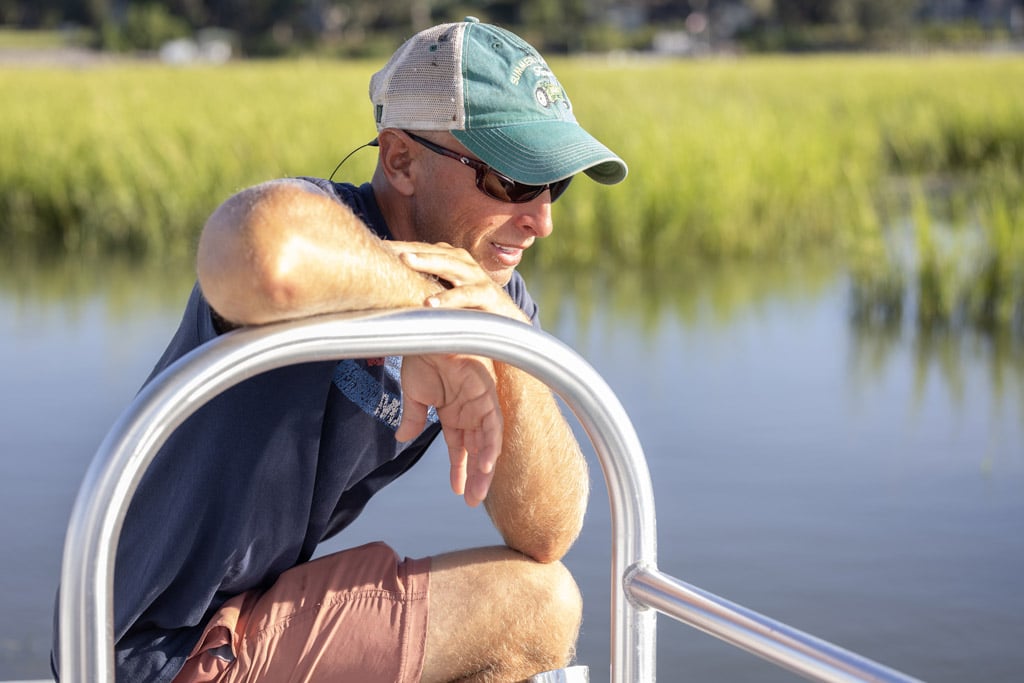

Being a Lowcountry local his entire life, Captain Chris Shoemaker is impressively at ease on coastal waterways. “I literally grew up doing this since I was five,” he said. “The love didn’t ever become; it’s just always been there. It’s a part of me.”
His Bluffton-based business, May River Excursions, offers dolphin tours, fishing excursions, island adventures, and sunset cruises for guests in Bluffton and Palmetto Bluff. By offering thousands of tours each year, customers always find something intriguing on his excursions. “Everybody is different,” Shoemaker said. “One person might catch a crab and they’re blown away. Then, a dolphin pops up, and they won’t even pay attention – while someone else might see a dolphin and they don’t even care about the crabs.”

Chris Shoemaker, owner of May River Excursions.
Spending so much time in local creeks, for work and pleasure, makes him knowledgeable about its environment. “Being out here every day, I can almost look at a picture and tell you, just from the marsh, what time of the year it is,” he said.
Showmaker also enjoys seeing the daily rhythms of other locals enjoying the May River. “You’ll see them out early every morning paddleboarding,” he said. “Then on the weekend, you see the same people going to the sandbar on their boat. There are just so many things for people to do.”
As a fishing guide, Shoemaker has easy access to fresh shrimp and fish but his favorite seafood is our local oysters. “I like them when the water is really cold,” he said. “January, February, and March are slower for me, so I’ll go out and pick three dozen and shuck them. I’ll get some lemon, a little minionette (sauce), and put them on the tray in the fridge. I’ll make a big deal out of it.”
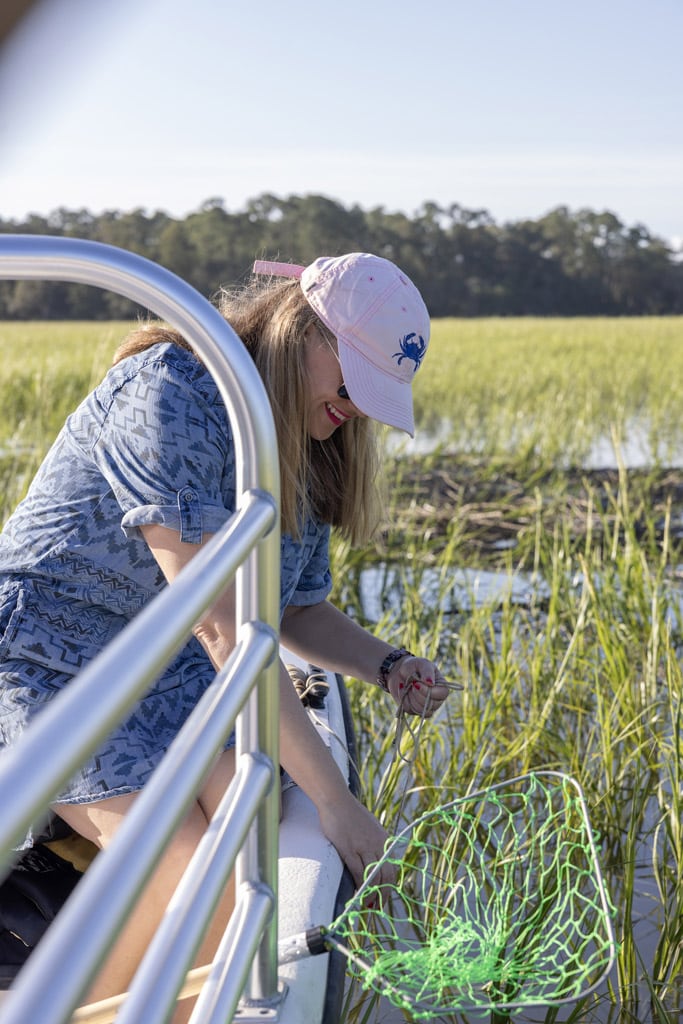
Brooke Peck slowly pulls up the rope, hoping the three crabs clinging to the chicken are big enough to keep.
CH2 Goes Crabbing
In addition to fishing and shrimping excursions, May River Excursions also offers crabbing encounters. In early September, Maggie Washo, Jevon Daly, and I headed out on one of these adventures to catch one of my favorite local sea creatures: blue crabs.
We met Shoemaker early that morning in Old Town Bluffton at the Calhoun Street dock. Once settled on his boat, Pluff Mud, we headed up the May River during high tide toward our crabbing spot. We passed expansive Palmetto Bluff estates on our left and watched Bluffton go by on our right.
In my experience, the best crabbing was during low tide. But since Shoemaker is a pro, I knew I was about to learn something new.
As the boat slowed, we turned into a small opening in the bright green marsh grass. “This is the spot,” he said.

September is one of the best months to go crabbing, as they are bigger in size and in more shallow water because it is still warm.
With the anchor secured, Shoemaker taught us the basics. Our necessary supplies included raw chicken thighs, a rope, and a net. “It doesn’t matter what kind of chicken you use but if you don’t have the net, you’re not going to catch any crabs,” he said.
He fastened the slimy chicken to a weighted hook on the ropes and tossed them in the water. With the lines tied to the boat’s cleats, it was time for us to get to work.
Every few minutes, one of us would slowly pull the rope towards the water’s surface while our partner stood close by with the net. As the chicken crested the water’s edge, we could see crabs attached to the chicken enjoying an early morning snack. They were completely unbothered by the slow descent towards the bright sun.
Then, the net person jumped into action by quickly scooping up the crabs and chicken. Shoemaker taught us the importance of scooping from underneath, not the side, to capture more crabs.

Shoemaker tosses a chicken trap into the marsh waters.
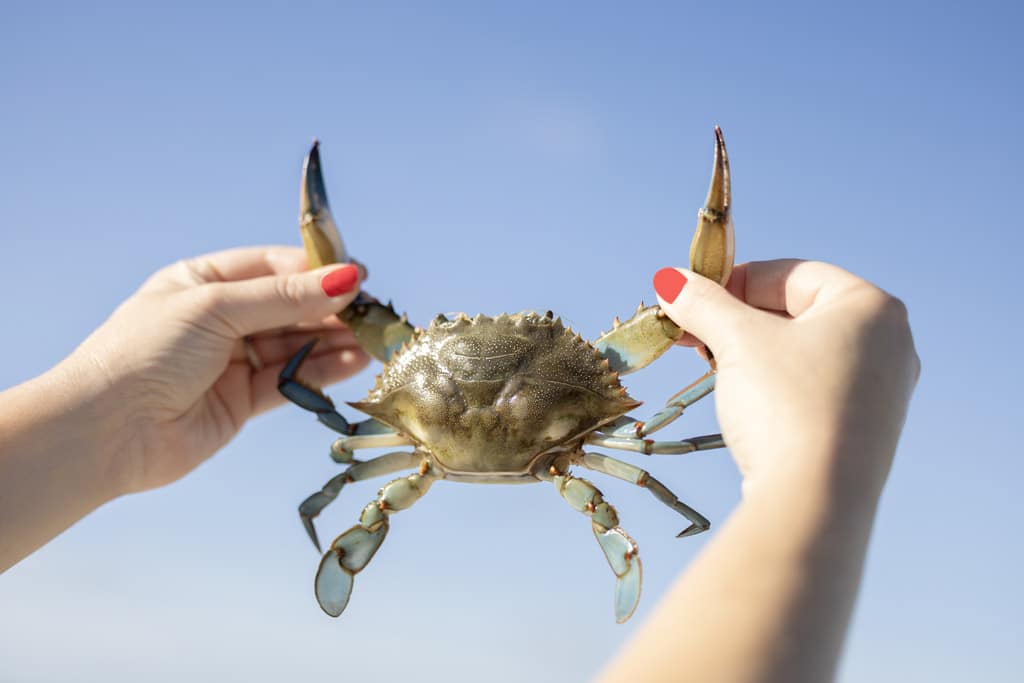
Next, came the dangerous part. Blue crabs are fast and feisty. Their speed and strong claws can severely pinch slow fingers so it’s important to know how to approach them. The captain taught us how to safely pick up a crab (from behind) and where to hold it (the back legs or halfway down the claws).
In order to be legally harvested in South Carolina, crabs must measure a minimum of five inches between the farthest tips of their shell. Conveniently, his boat has a life-sized crab sticker that helped us measure our crabs. Anything smaller, we put back in the salty water to live another day. Anything larger, we held onto for lunch.
Blue crabs are in our area year-long but the crabs move to various locations throughout the year, depending on the water temperature. In the late spring, as the water temps warm up, the crabs move into shallower water in creeks. In the fall, as temps drop, the crabs move out to deeper water. “Two months from now, I’m not catching anything right here,” he said. “I won’t catch anything here until probably May.”

CH2’s Brooke Peck, Maggie Washo, and Jevon Daly take on blue crab hunting with Chris Shoemaker.
We spent about 45 minutes working the lines, catching crabs, and measuring their sizes. Thanks to Shoemaker’s coaching, we all learned how to pick up a crab and avoided getting pinched. We caught more than a dozen feisty crabs and were ready for part two of our adventure: enjoying the crabs for lunch.
We headed to Hudson’s Seafood House on the Docks on Hilton Head Island for lunch with our fresh catch in tow. May River Excursion guests can bring their crabs to Hudson’s to have them steamed for free. This arrangement is in place because Shoemaker and Andrew Carmines, Hudson’s owner, are first cousins. Crabbers just need to bring their own bucket for transportation from the dock to the restaurant.
After proudly presenting our freshly caught bounty to our server, we settled at an outdoor table. Daly and I were ready to clobber the crabs but Washo was a bit more hesitant. However, before the crabs could arrive, a sudden downpour sent us scampering into Hudson’s back dining room.
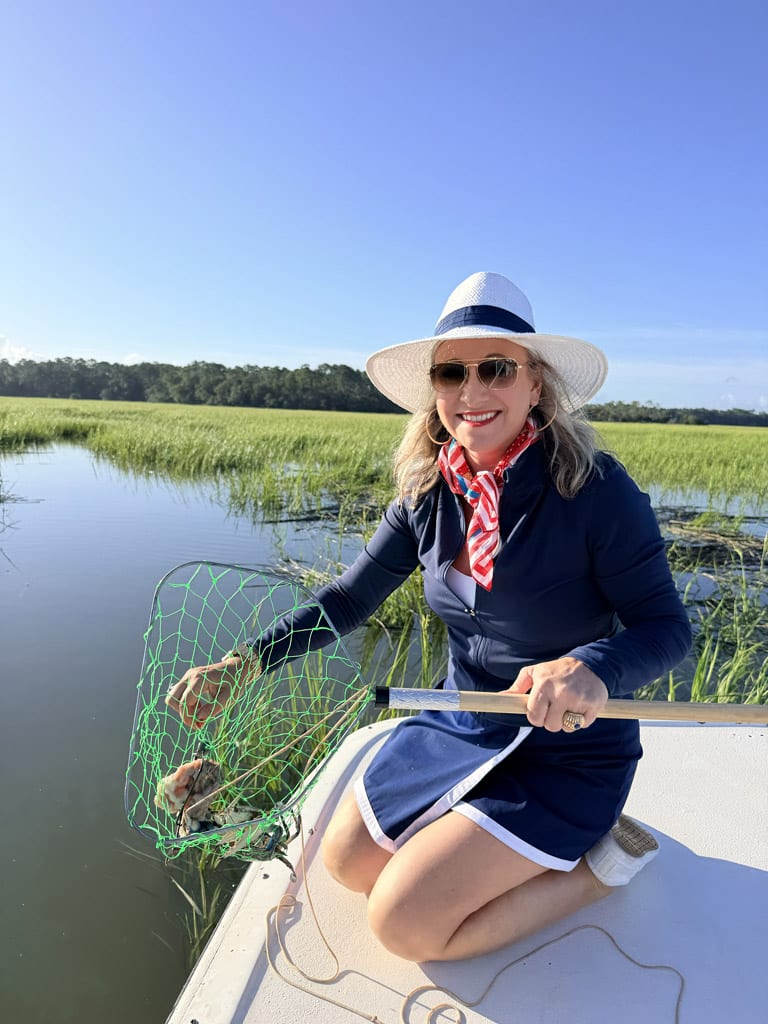
Washo nets a crab a tad too small to keep.
Once we dried off, the hot steamed crabs arrived, sprinkled with Old Bay Seasoning. To be honest, dining on blue crabs isn’t for the faint of heart. It’s messy. You just have to get in there by removing the carapace, scooping out the innards, and working hard to remove the shell to find the soft, white meat.
In general, most of the meat is found in the claws or in the body near the legs. The claws are the easiest to open with a hammer or crab cracker. It’s similar to enjoying Alaskan crab legs. However, the internal crab meat is trickier to access but, in my opinion, its tenderness is totally worth it. If you’ve never picked crabs before, it might be worth watching a five-minute tutorial to get your bearings.
We easily polished off the crabs plus salads, reel deal shrimp, hushpuppies, and key lime pie for dessert. Even with all the hard work, eating blue crabs with friends is one of my happiest moments in life. It’s leisurely, casual, enjoyable, and a great time of togetherness. The whole day was a fun, educational outing from start to finish.
May River Excursions offers crabbing experiences year-round but the location and technique change depending on the season. Visit mayriverexcursions.com for more information.