


It’s just before midnight on a Sunday, which means Reggie Deas is under the lights at Hilton Head Island’s Jazz Corner, microphone in hand. He smiles warmly at his audience as the band hits the last notes of their closing song, wrapping up their second sold-out show of the night.
By 8 a.m. the next morning, he will be in Beaufort, behind his desk at the county’s school district office with a full day’s work ahead of him. When the clock hits five, he’ll grab his signature black blazer and make the switch again, this time performing at a private event.

Reggie Deas
For Deas, such strenuous hours are nothing out of the ordinary. His band, Deas-Guyz, plays year-round, three to four times per week, a schedule most local musicians would consider full-time. Not for Deas. He balances more than 200 gigs a year with an entirely separate full-time career as Beaufort County Schools’ human resources administrator.
His story reflects a greater concept behind many of the Lowcountry’s working musicians: making a living and making art don’t have to be mutually exclusive. Hilton Head Island is home to performers and artists who have carved their own paths to make room for both – some building careers that exist alongside music, others allowing their creative pursuits to take a different form. Across the board, there is no single formula, only a shared refusal to choose between the two.
Deas arrived on Hilton Head in 1999 and less than a year later, Deas-Guyz was formed. Velvety and nostalgic, his commanding vocals on classic Motown anthems made Deas-Guyz a fast favorite among island locals. Through the decades, their ever-loyal audience has packed parks and venues across the region, filling lawns with folding chairs. Deas’ voice captivates and moves, often compelling audiences to sing along and dance as they eagerly mouth the words to old favorites by Marvin Gaye and the Temptations.
He describes both of his roles as opportunities to connect with people, just in different capacities. “During the day, I’m helping people solve problems, and at night I’m just helping people feel happy,” he said.
Deas has logged more years in education than he has as a frontman. Currently in his 36th year working in the education system, the end of this school year will mark the point at which educators have the option to retire. Despite the long nights and early mornings, when the time comes next year, he believes he’ll continue with each of his professions. “Both my colleagues in education and my band members would say that I always show up for work,” he said. “I feel very blessed.”
Reggie Deas isn’t the only one working in duality. Across the Lowcountry, lawyers, teachers, real estate agents, and brokers are trading laptops and business calls for guitars and drumsticks after the workday ends.

Ben Russ
Mortgage loan originator Ben Russ is another case in point. A pianist since the age of three, Russ grew up in a music-centered family. In college, his classical training earned him a spot in Clemson University’s orchestra. It was around this time that Russ realized music could offer him something else: a way to earn money. Wanting something new, he picked up the guitar and began playing in downtown bars a few nights a week.
Those late-night checks ended up paying for most of his schooling. Upon graduation, he moved to Hilton Head, and while searching for a daytime career, turned once again to music for employment, playing nearly every night.
These days, he thinks of music more as a hobby. In 2003, he landed in the mortgage business, a position that would stick. Establishing himself in the professional world also allowed him to take the pressure off needing to make money from music. “Now, it’s really more of a way to decompress, focus on something artistic, and have fun with people that I enjoy being with,” he said.
A father of three, Russ most often chooses to play on the weekends. He exercises his genre versatility through his involvement in a few separate projects, including Rolling Stones cover band White Liquor and classic country outlaw group Georgia Overdrive. He recently debuted his latest endeavor, a ’90s alternative rock band called White Bronco, to a packed house at Pour & Proper on the island.
The audience that night offered a fitting mix of Russ’s two worlds, with familiar faces from his professional life mingling with those who had simply come out for the music. Among them was Russ’s sister, Amanda Cifaldi. Woven into the fabric of the Russ family, a connection to music runs just as deeply through Cifaldi’s life. Her younger years were filled with song, eventually leading her to musical theatre, a touring career with the Young Americans, and, later, a decade of playing in bands alongside her brother.

Amanda Cifaldi
Her professional path took a more winding route. After considering law school, Cifaldi discovered a passion for hospitality while working in Charleston restaurants. She eventually moved to Italy to attend culinary school, relocated to the Lowcountry, and, in a leap of faith, opened Pomodori. Fifteen years later, she owns and operates two successful locations, including neighborhood gem P2 in Bluffton, where she regularly books local musicians (sometimes even ditching the apron to get onstage herself).
Cifaldi feels the two worlds have become less like competing careers and more like complementary forces. “I get to do it purely for the release and the fun,” she said. “I don’t have to make a job of it.” Her restaurants provide the financial stability that allows music to remain a creative outlet, while music gives her the release she needs to return to the demands of running a business.
The two identities are so intertwined that Cifaldi doesn’t distinguish between them. Her first two tattoos tell the story: Her grandmother’s saucepot, wooden spoon, and tomato plant adorn one arm, while a treble clef honoring her grandfather adorns the other. “I love both things equally, and I don’t have to choose,” she said.
For Cifaldi, that choice is the point. She believes there will always be reasons not to pursue a creative dream, but fear shouldn’t be one of them. “You get one ride on the merry-go-round,” she said. “The ‘hard’ is what makes things great.”
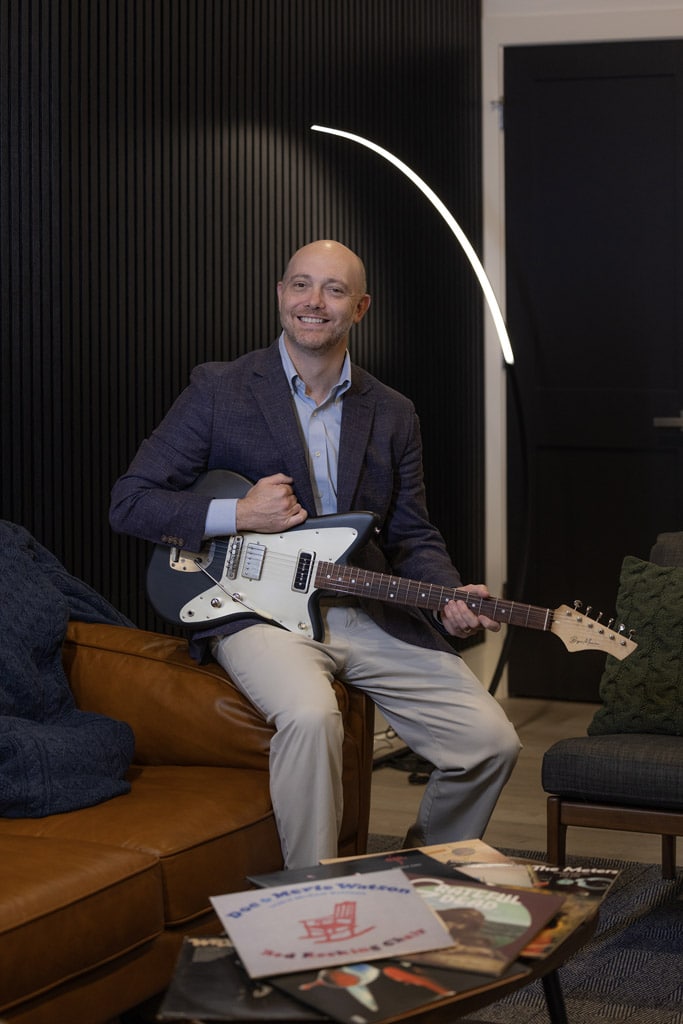
Ben Shelton
Equally devoted is island attorney Ben Shelton, whose creative life has remained a part of him through every point of his professional career. Music was never something he had to seek out. Both of his parents were music teachers, and their North Carolina home was filled with classical, folk, and traditional Appalachian music. Shelton learned trombone, sang in choirs, and mastered the guitar, mandolin, and upright bass.
While obtaining an undergraduate degree in classical voice, he felt evenly pulled to another calling: law. After college and a year of teaching music, he moved to Charleston, where he began gigging full-time while working toward law school. At the height of that period, Shelton gave himself a true taste of the graveyard schedule of a working artist, playing six nights a week until four in the morning.
When his band eventually broke up, he decided it was time to take the LSAT. A heroic radio story on hospitals hiring lawyers to represent tenants exposed to mold in overcrowded housing inspired him to solidify his decision to pursue law. Shelton recalls realizing he was through with the late nights. “I decided I didn’t want to be a vampire,” he joked.
Today, he runs his own law firm, a career he has built over years of practicing in every court of the 14th Judicial Circuit. Ever dedicated, law comes first for him, a priority he believes his clients deserve. Still, he maintains an active musical life, playing about once a month as the lead guitarist and vocalist for King Tide and the Royal Sound, a three-piece group that blends original music with an eclectic mix of covers.
As Shelton sees it, the connection between his two professions runs deeper than simply balancing a schedule. Both demand immense preparation, creativity, and, ultimately, the ability to perform under pressure. “I can’t think of a better major for someone who wants to be a trial lawyer than a classical vocal major from a liberal arts school,” he said.
The preparation skills he practices in the courtroom are particularly important to Shelton as a musician. He would rather play fewer shows than take the stage ill-prepared, aiming to give audiences something that feels far removed from a part-time pursuit. With a demanding legal career and a family at home, time is his greatest constraint, but Shelton sees no need to choose between the two. “If you love it, you’ll find the time,” he said.
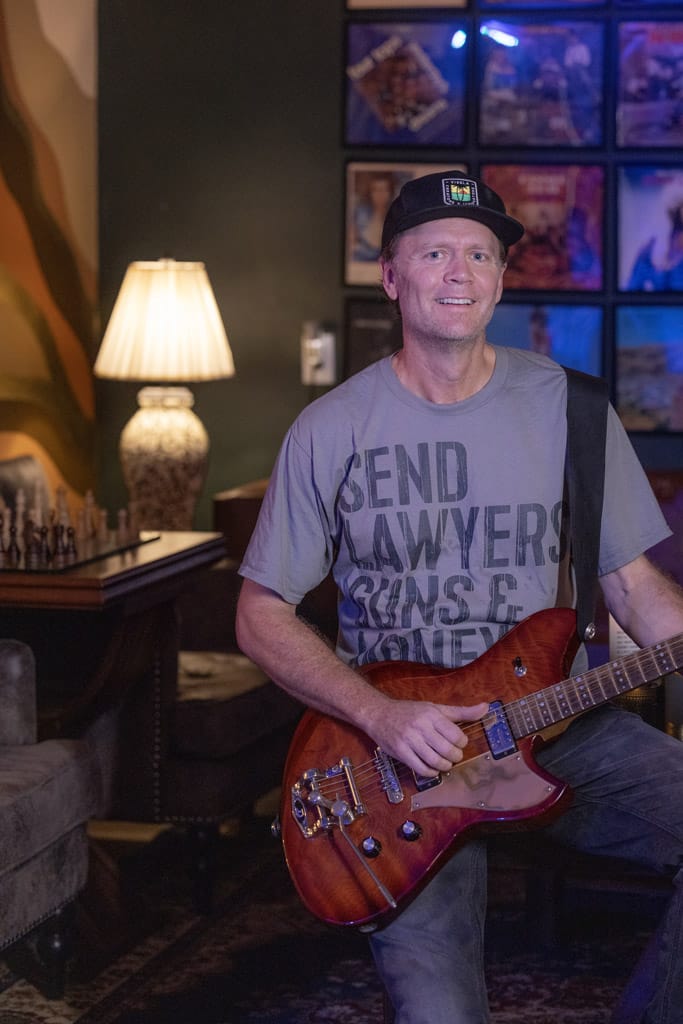
John Wilkins
Joining him among the ranks is fellow attorney John Wilkins, whose path took somewhat of a similar route. In his case, however, becoming a lawyer was never exactly the plan. Music, on the other hand, was there from the beginning. Wilkins grew up in a musical family, surrounded by pianos and guitars. His mother taught him the basics of guitar, but he quickly discovered that he preferred playing by ear to reading music. By college, he was performing in acoustic duos, playing parties for tips, and eventually taking his place as a key player in an up-and-coming Atlanta band. He chose to step away from his band in favor of law school in Columbia. There, he became involved with another thriving group – a six-piece ska band that began gaining traction locally, cutting an EP and headlining area venues with an all-original song list.
With music moving forward and a legal career taking shape, upon finishing his studies Wilkins found himself at another crossroads. Ultimately, he chose to move forward professionally without completely abandoning music. After graduating from USC, he moved to Hilton Head in 1997 for a career in law and quickly slid his way into the local music scene. Throughout the years, he has played with a lengthy list of Lowcountry bands, including Jojo Squirrel and the Home Pickles, Trophy Wife, Martin Lesch Band, Cepheus, M.O.B., Cranford Hollow, White Liquor, the Storks, and Soundboy. Presently, he joins Ben Russ in White Bronco and sits in with other groups when time allows.
Though his legal career was not always envisioned, Wilkins has long possessed a desire for the two worlds to coexist and even overlap. His practice primarily involves real estate and business transactions, but when afforded the opportunity he eagerly ventures into entertainment law to assist bands and artists on legal matters (structuring, review, and negotiation of management, performance, or licensing agreements, etc.), an area of true passion for him.
As far as time spent onstage, the balance for Wilkins has changed over the years. At the start of his career, he was working full time in addition to playing up to five shows a week. As time passed and family responsibilities grew, that number dwindled to just a handful of shows a year. Paradoxically, the less he played, the more he wanted to. “When it’s a constant thing, it can start to feel like a job,” he said. “I became hungrier for it. It made each performance more special.”
Today, Wilkins feels he’s settled into a comfortable rhythm, though he’d happily make more room for recording original music. His legal career provides the stability to pursue music on his own terms, while music offers something the office can’t – the adrenaline and emotional satisfaction of a special performance. His philosophy is simple: Creativity has no expiration date, and there doesn’t have to be a single path forward.
“It’s never too late,” he said. “You can switch gears. You can do it as a hobby, career, or anything in between.”
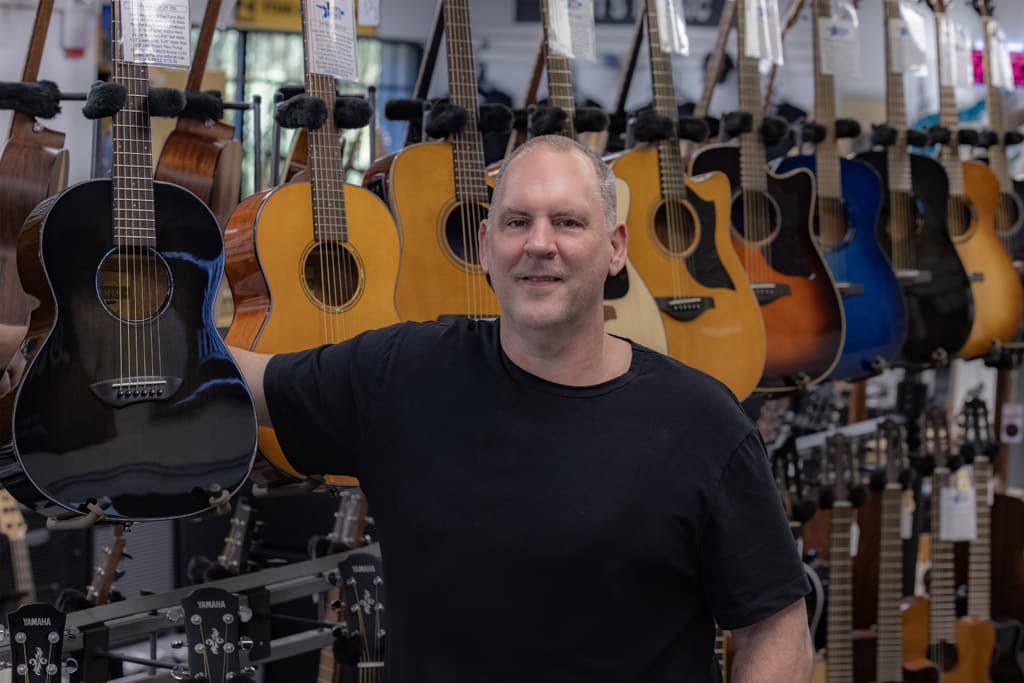
Scott Evans
For Scott Evans, the line between making a living and making music is a little blurrier. Originally from the northeast, Evans began playing guitar at 16, eventually joining bands in college and continuing to play on weekends while working corporate jobs throughout the 1990s. A self-described “weekend warrior,” he played a range of genres from hard rock and metal to original music, inspired from childhood by theatrical rock acts like KISS.
That weekend pursuit eventually led him to a career built around music itself. Evans left the corporate world to move to Hilton Head in 2006. In 2010, he purchased John’s Music. The store is both his profession and a cornerstone of the island’s music community. When Evans isn’t assisting customers or repairing instruments, he’s playing guitar with Heavy Equipment, a local cover band that moves from Pink Floyd to A Flock of Seagulls, playing songs people love, but not necessarily the ones they hear from every other cover band.
For Evans, playing in the band is a release from the responsibilities of running a business, and even more importantly, a chance to spend time with the community of musicians he has come to know so well. Owning the store has its perks, too. “I’m able to get whatever is needed to support the band,” he said. He also enjoys the hands-on side of the business, having spent years learning to repair and modify musical gear.
“I control my own destiny,” he said of being a business owner. “Good or bad, it’s mine.” Evans said the decision to buy John’s Music feels like the career path he should have taken from the very start. These days, he wakes up knowing that, in one way or another, he’ll be surrounded by music. “Every day is fun,” he said.
For these musicians, there is no rule book for balancing a creative life with a career. Some play hundreds of shows a year; others wait for the weekends or a few nights a month. Some have built careers entirely separate from music, while others prefer merging their professional lives directly with the music community.
What they share is the belief that making a living doesn’t have to mean giving up the thing that makes life worth living. In the Lowcountry, they’re proving there’s room for both.