


For Amiri Farris, art has never been something confined to a canvas or displayed only inside the quiet walls of a gallery.
Art is on buildings and in stadiums. It is found in food and fashion, nature and architecture. It lives in history, heritage, community, and in the everyday objects we rarely stop to consider. Sometimes, it even comes to life before an audience, with Farris standing in front of a blank canvas and allowing people to watch the creative process unfold.
At the heart of his philosophy is a simple motto: “Art is everything.”
“Art is all around you,” Farris said. “It’s in nature, the clothes you wear, the car you drive, the buildings you walk into, and even the phone or magazine you’re reading this on. At some point, someone had to imagine it, design it, and use creativity to bring it into the world.”
For roughly two decades, Farris has built a career around that expansive view of creativity. A painter, muralist, illustrator, sculptor, educator, and mixed-media artist, he has created work throughout the Lowcountry and beyond while developing a visual language that is distinctly his own.
But beneath the color, movement, and contemporary energy is something deeper: a profound connection to the Gullah Geechee people and a desire to honor the people, stories, and traditions that shaped him while making room for what comes next.

Amiri Farris created the large mural adjacent to Okan, entitled The Joy of Bluffton: A Celebration of Old Town.
Encouraged to Create
Farris’ artistic journey began long before he knew where it would lead.
Growing up in West Palm Beach, Florida, he was fortunate to have people around him who recognized his creativity early and encouraged him to develop it.
“My own artistic journey started when I was very young,” Farris said. “Beginning around age six, I had opportunities to study art at the Armory Art Center in West Palm Beach and to train at Quest Theatre and Institute.”
He later attended New World School of the Arts in Miami before continuing his education at Savannah College of Art and Design, where he ultimately earned his master’s degree in painting after completing undergraduate studies in illustration.
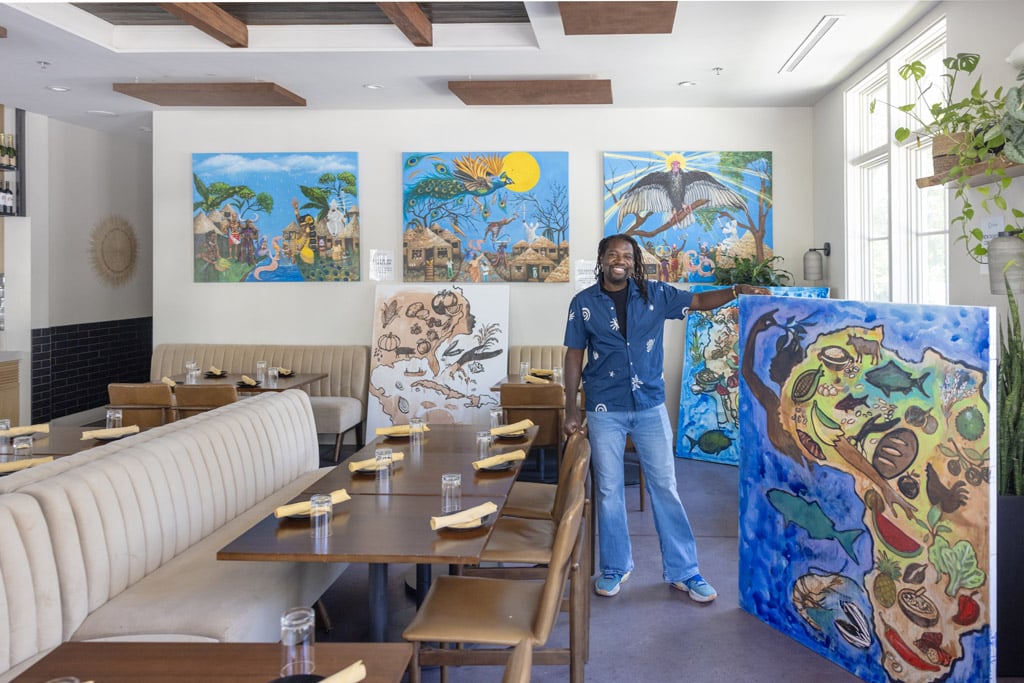
Farris surrounded by artwork at Okan in Old Town Bluffton.
“At every stage, I was surrounded by creative individuals – artists, educators, and mentors – who recognized something in me and helped guide me toward becoming the artist I am today,” he said.
His education extended far beyond painting. Farris studied photography, computer graphics, sculpture, and other disciplines, experiences that gave him the freedom to move among various media throughout his career.
“I pretty much have studied every art genre,” he said. “Since I was able to study all those different mediums, I’m more able to use it in my work or on different projects.”
After graduating from SCAD, Farris made the Lowcountry home. Among his early positions was serving as art director at the Boys & Girls Club, a role that foreshadowed the importance education and mentorship would continue to have in his career.
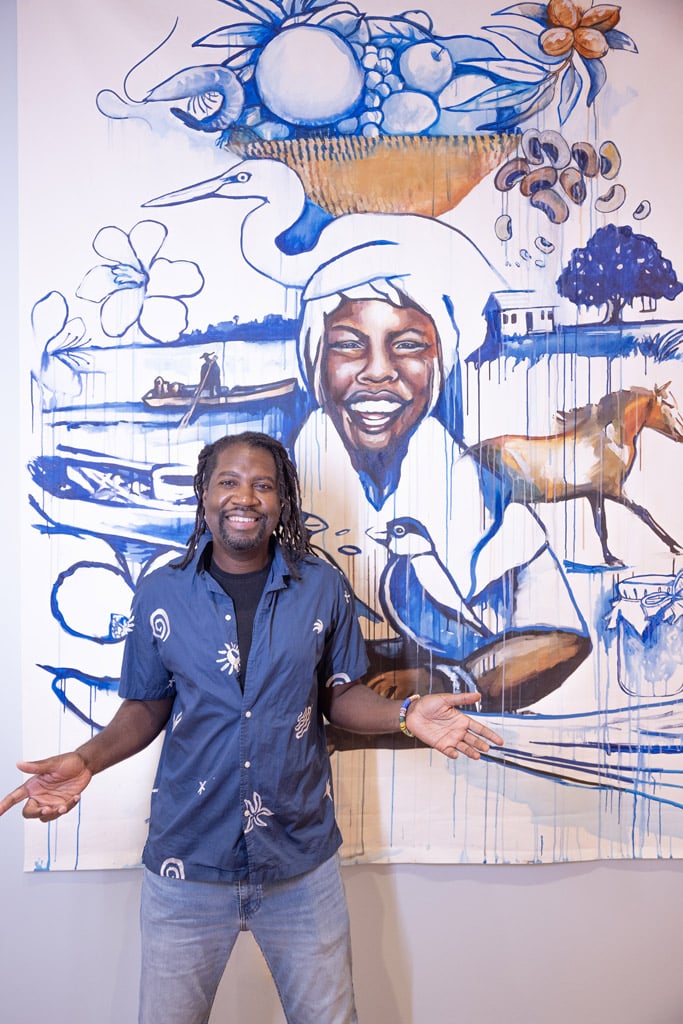
Farris’ artwork is showcased at the Montage in Palmetto Bluff.
Finding His Own Visual Language
At his core, Farris considers himself a painter, but limiting a description of his work to a single medium would be nearly impossible. He incorporates collage, mixed media, sculptural elements, and symbolism, selecting materials according to the story he wants to tell.
“I don’t necessarily have a favorite,” he said. “It just depends on the project that I’m working on and what I’m trying to convey to the audience or to the viewer.”
Increasingly, those projects have grown in scale.
Farris’ murals and public artworks can be found throughout the Lowcountry. At Hilton Head Island’s rowing and sailing center, a mural honors shrimpers and those who helped preserve the area’s ecosystem. Another appears at the Boys & Girls Club. In Bluffton, his work can be seen at the Culinary Institute of the South, Kroger on Buckwalter Parkway, Okan restaurant, and other community spaces.
His reach extends far beyond the region. At Atlanta’s Mercedes-Benz Stadium, Farris created a dynamic image of a soccer player kicking a ball, deliberately rendering the athlete ambiguously rather than depicting one particular player.
Yet, even as his canvases have grown, Farris’ work remains unmistakably personal.
“When you visit a lot of galleries and art spaces in this area, you tend to see many of the same traditional subjects – landscapes, egrets, marsh scenes – and I appreciate those subjects, too,” Farris said. “But when I paint an egret, a crab, or a Lowcountry landscape, I want to approach it through my own visual language. I want it to feel contemporary, unexpected, and unmistakably mine.”
That visual language is deeply rooted in the Gullah Geechee culture, history, and traditions of the Sea Islands.
Throughout his career, he has exhibited and created work across the Gullah Geechee Cultural Heritage Corridor and collaborated with cultural institutions and community organizations, including the Gullah Museum of Hilton Head Island.
The people, landscapes, stories, foodways, and traditions of the Lowcountry regularly appear in his work, but Farris does not simply reproduce familiar imagery. He reinterprets it through bold color, contemporary composition, and mixed media, creating a bridge between cultural memory and modern expression.
That connection became especially meaningful when Farris was selected as featured artist for the 35th anniversary of the Hilton Head Island Gullah Celebration. The recognition allowed him to celebrate a culture represented in his artistic practice while introducing its stories to new audiences.
His work has also been shown throughout Hilton Head Island, including at J. Costello Gallery at Red Fish, while exhibitions, public art, educational programs, and community events continue his commitment to carrying those cultural stories forward.

Farris is photographed next to a commissioned piece of artwork at a home on Hilton Head Island Island.
For Farris, honoring tradition does not mean standing still. One of the most engaging aspects of Farris’ work is his willingness to create it in public.
“I do a lot of action painting, which is painting in front of people live,” he said. “People are very surprised that I’m so comfortable just painting in front of people because usually, when you’re working as an artist, it’s a very intimate sort of practice.”
Farris prefers to open up that process. “I like to bring it more into a larger audience so they can see how I work,” he said.
At Okan in Bluffton, he has been doing just that, creating paintings live on Thursday evenings. One recent series explores foodways and the movement of food and culinary traditions from Africa and South America through the Americas.
The subject beautifully intersects with his larger body of work. Food, like art, carries history. Recipes travel. Traditions evolve. Ingredients and techniques tell stories about migration, survival, family and cultural exchange.
And as Farris paints, viewers get to watch those stories emerge in real time.

One of Farris’ newest works of art is featured on the exterior of the Bluffton Bookstore.
Opening Doors for the Next Generation
Farris can trace one of his earliest career milestones all the way back to high school, when a self-portrait he created was selected for display at the U.S. Capitol. “That really helped me push my career,” he said.
Sarah Jessica Parker served as a judge and speaker for the program that year, making the experience even more memorable for a young artist preparing to enter college.
More recently, Farris has worked with acclaimed actress and educator Phylicia Rashad in connection with the Brainerd Institute Heritage in Chester, South Carolina, contributing artwork and participating in youth-centered programming. The experience brings together two important parts of his creative life: making art and creating opportunities for others.
“I really enjoy inspiring young people because I know how much it meant to me as a younger creative person to have people who encouraged me and helped guide me along my journey,” Farris said. “Sometimes having someone recognize your creativity, expose you to new possibilities, or simply tell you to keep going can make a lasting impact. I want young people to know that their ideas and their voices have value.”
It is the natural continuation of what others once did for him. The child whose creativity was recognized at age six now has the opportunity to recognize that same spark in someone else.
Expanding the Creative South
Farris is now preparing for another evolution in his career. In addition to having work represented at Montage Palmetto Bluff, he serves as an artist laureate and artist-in-residence at the Technical College of the Lowcountry. He is also preparing to open his Beaufort studio as a space where visitors can experience exhibitions and installations by Farris and other artists.
His vision is decidedly contemporary. The goal is not to reject the artistic traditions of the South, but to expand how Southern art is perceived.
“I really want to push the boundaries of what people expect us as artists to look like,” Farris said. “There are so many contemporary artists in the South creating innovative work and telling powerful stories in new ways. I want to create a space where that work can be seen, where artists can experiment, and where people can experience another side of the creative South.”
It is an ambition that seems especially fitting for an artist who has spent his career refusing to stay inside prescribed lines.
Farris moves between painting and sculpture, gallery and street, heritage and experimentation, private creation and public performance. He can paint a Lowcountry egret without painting the egret we have seen a hundred times before. He can draw from centuries-old cultural traditions while making something that feels entirely of this moment.
And he can use the success he has earned not only to create more art, but to make room for more artists. After all, if Farris is right – and art really is everything – then creativity belongs everywhere – and to everyone.
To learn more, visit AmiriFarris.com.