


When Hilton Head Dance School opened in May 1985, it began with a single studio, a rolled-up dance floor, and just 17 students. It was modest, makeshift, and full of possibility. Four decades later, that small beginning has grown into one of the island’s most enduring cultural institutions. It is an organization whose staying power comes not only from artistic excellence, but from its deep roots in the community, its devotion to discipline and training, and its unwavering belief that dance can shape lives.
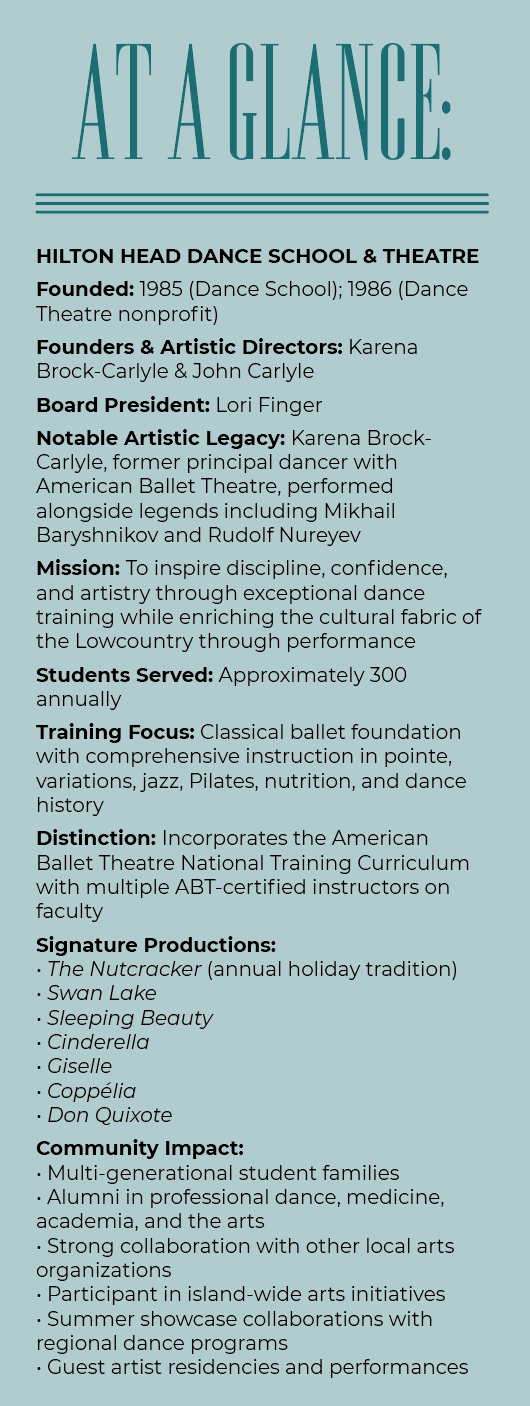
At the center of that legacy are Karena Brock-Carlyle and John Carlyle, the school’s owners and artistic directors, and Lori Finger, board president of Hilton Head Dance Theatre. Together, they represent the artistic vision, practical leadership, and community stewardship that have sustained the organization for 40 years.
What they have built is far more than a dance school. It is a place where children grow into artists, artists grow into leaders, and generations of Lowcountry families have found beauty, belonging, and purpose.
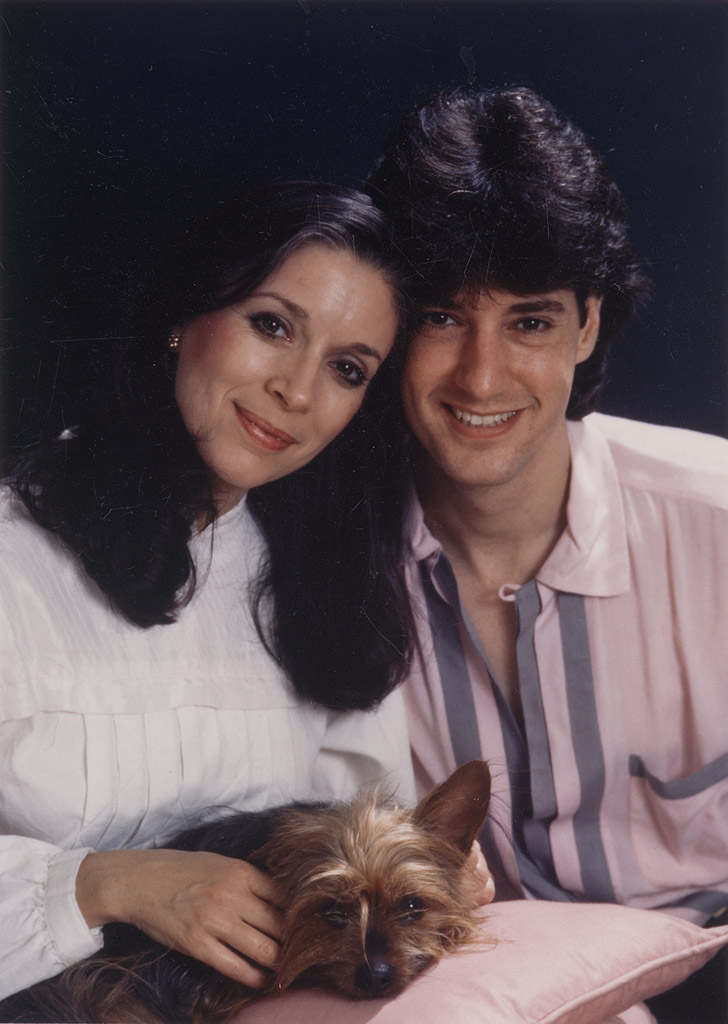
Karena Brock-Carlyle and John Carlyle, circa 1987
A Remarkable Beginning
Hilton Head Dance School did not begin with a business plan so much as an invitation. Before arriving on Hilton Head, Karena Brock-Carlyle had already enjoyed an extraordinary professional career. A principal dancer with American Ballet Theatre (ABT), she had shared roles with renowned stars including Natalia Makarova and Cynthia Gregory and had been partnered by ballet legends Rudolf Nureyev and Mikhail Baryshnikov. Her training had taken her from Texas to California, Amsterdam, and ultimately to the company she had long dreamed of joining. She spent 15 years with ABT, building a career most dancers only imagine.
After leaving ABT, Brock-Carlyle became artistic director of the Savannah Ballet. It was there that a Hilton Head connection took shape. Margaret Jones, who served on the Savannah board, and Mary Coleman approached her about coming to the island to open a school. Brock-Carlyle had not been planning that move, but she said yes, and that decision changed Hilton Head’s arts landscape.
John Carlyle came into the story through dance as well. He had also danced professionally, including a brief period with ABT, and joined Brock-Carlyle in Savannah after she invited him to teach and dance there. Their professional partnership evolved into a personal one. In fact, between opening the Hilton Head school in May 1985 and launching their first full season in the fall, the two got married, making the beginning of the school inseparable from the beginning of their life together.
“It’s been a dream ever since,” Brock-Carlyle said of the move and the decades that followed.
Two players in achieving that dream are Allyson and Joe Harden, who were instrumental in finding the building that the school and theatre occupy to this day. The couple also helped to renovate the space and create two studios outfitted with sprung floors and barres. After 40 years, the school and theatre own the entire building and have three studios, a costume shop, storage space, and office space.

Karena Brock in Les Patineurs alongside Mikhail Baryshnikov
From Principal Dancer to Teacher of Generations
If Brock-Carlyle brought prestige to Hilton Head from the start, she also brought something even more important: standards.
From the beginning, she and Carlyle were determined to create not just a recreational program, but a serious school of dance – one grounded in classical technique, artistic integrity, and discipline. That level of commitment was unusual for a growing island community, especially in the mid-1980s, but it quickly resonated.
The early days were far from glamorous. In the first studio, Carlyle had to unroll the dance floor before classes and roll it back up afterward so the space could serve multiple purposes. Yet even in those humble circumstances, the school’s vision was clear.
Carlyle summed up their philosophy simply: “As long as we stay true to the art, we get kids that are dedicated to it, devoted to it.”
That devotion has become one of the school’s hallmarks. Students often begin as small children and remain all the way through high school graduation. As Brock-Carlyle noted, when a family stays with the school from age 3 to 18, “that develops a pretty deep relationship.” Over the years, those relationships have multiplied into something even more meaningful: generations. Former students now return as parents, and in some cases, even their children are dancing in the school.
One especially meaningful example is a former student who started in 1987 as a 4-year-old, stayed through high school, studied dance in college, performed professionally, then returned to teach at the school. Today, her own daughter – named Karena – is a student there. That kind of full-circle continuity says more than any anniversary banner ever could.

Mary Coleman at the old Dunnagan’s Alley Theater
The Nutcracker Effect
The school’s real turning point came with its first encounter with performance. After opening, Brock-Carlyle approached the late Bill Dunnagan of the Hilton Head Community Playhouse and asked whether the dancers might have a little stage time to present a small portion of The Nutcracker. At the time, they only had enough students to do the snow scene and Act II.
It sold out.
That response revealed something powerful: Hilton Head wanted dance. More than that, it was ready to embrace it as part of the cultural life of the island. After that first success, Dunnagan invited them to produce The Nutcracker and offered theatre space each Christmas and spring. For about 10 years, until the Arts Center of Coastal Carolina opened in 1996, the organization performed at Dunnagan’s Alley. It was a formative partnership and one of the earliest signs that Hilton Head’s arts organizations were willing to work together rather than compete.
That spirit of cooperation remains one of the organization’s defining strengths. “A high tide lifts all boats,” Finger said, describing the atmosphere among the island’s arts institutions.
Today, The Nutcracker remains central to Hilton Head Dance Theatre’s identity, but it is far from the only production that has shaped the company. The official repertoire includes such classics as Swan Lake, Sleeping Beauty, Cinderella, Giselle, Coppélia, and Don Quixote, along with original works – evidence of both artistic ambition and remarkable longevity.

The exterior of the building in Palmetto Business Park that Hilton Head Dance has occupied since 1986.
School and Theatre: Two Arms of One Mission
A key part of the organization’s success is the way its two branches work together. The dance school, founded in 1985, is the training ground. The dance theatre, founded in 1986, is the nonprofit performing arm. The school develops dancers; the theatre creates the productions, raises support, handles logistics, and makes large-scale performance possible. The theatre’s mission is to foster an appreciation of dance as an art form in the Lowcountry, while the school prepares students with the technique and discipline to carry that art forward.
Finger explained that this division of labor is essential. The theatre handles ticketing, venue rental, publicity, guest artists, printed programs, costumes materials, and the website. It also manages contributed support and memberships, which are crucial to sustaining productions. That structure frees Brock-Carlyle and Carlyle to do what they do best: teach, rehearse, choreograph, and produce.
The relationship is unusually strong, and it works because each side respects the other. Finger describes the board’s role as creating the conditions that let the artists focus on art. Brock-Carlyle put it even more bluntly: Without the theatre, “we wouldn’t be doing the shows that we do.”
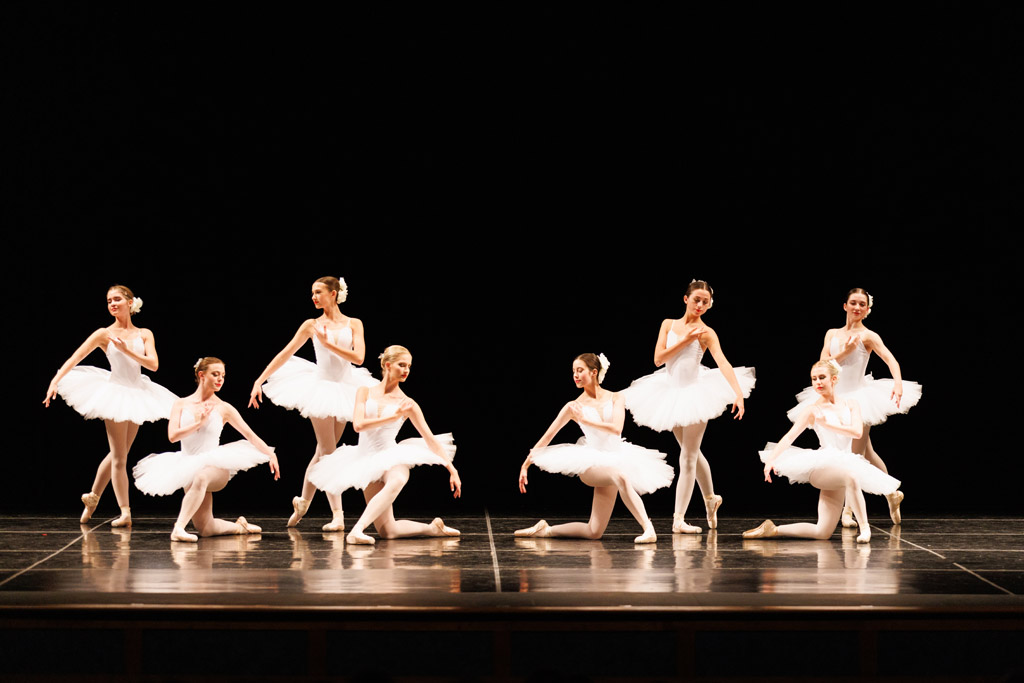
Terpsichore 2022
Excellence in the Studio
For an institution built on classical training, faculty matters enormously. Here, too, Hilton Head Dance School & Theatre stands out.
The school proudly includes the American Ballet Theatre National Training Curriculum, an age-appropriate, outcome-based program designed to support strong technique, dancer health, and child development. The academy program for middle and high school students offers ballet, pointe, variations, jazz, Pilates, nutrition, audition preparation, and dance history, giving serious students a deeper and more accelerated path.
Brock-Carlyle, an ABT Certified Teacher, has completed ABT teacher training from Primary through Level 7. The faculty also includes several other ABT-certified instructors, including Katie Girardi, Jamal Edwards, and Caitlin Hoffman. Girardi, a graduate of Mercyhurst University, also teaches Pilates and brings a deep understanding of alignment and body mechanics. Edwards, a University of Alabama dance graduate, works throughout the Lowcountry as a dancer, choreographer, dance instructor, and Pilates instructor. Hoffman, a University of Maryland graduate, brings additional training in ballet, jazz, tap, and Pilates.
Brock-Carlyle spoke with obvious pride about that faculty. “Our faculty is outstanding,” she said. “That strength matters not just for prestige, but for safety and longevity.” She noted that dance teaching is one of the few disciplines where formal certification is not universally required, making the school’s embrace of ABT curriculum and credentialing all the more significant.
That insistence on quality is one reason the school has earned such trust over four decades.
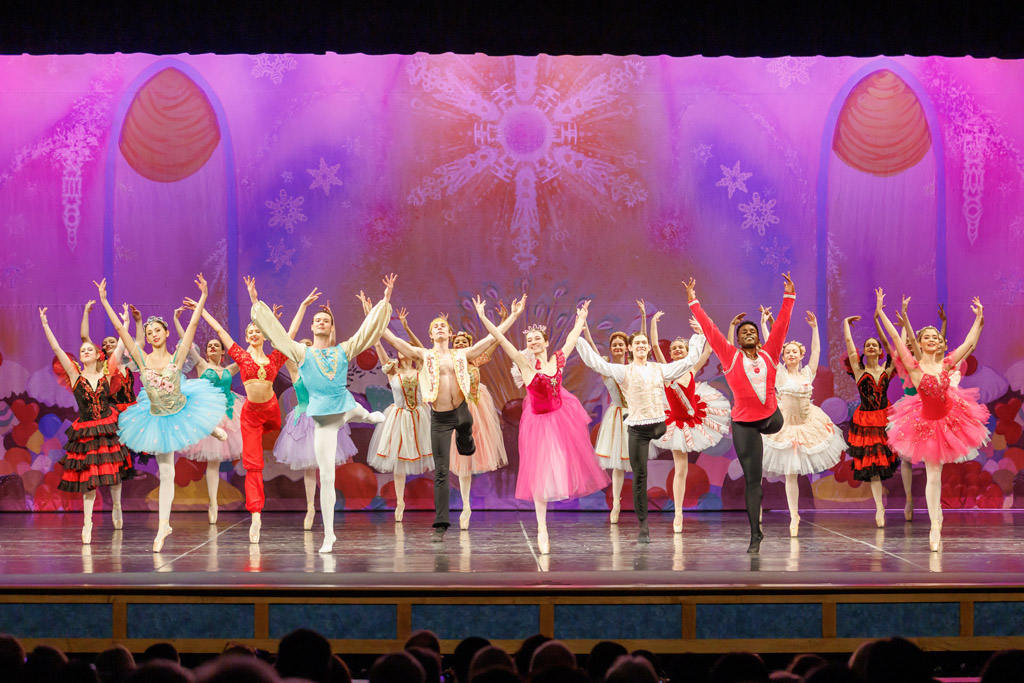
The Coda of the Nutcracker 2022
The Students and What They Become
Ask the artistic directors what makes them proudest, and the answer comes quickly: the students.
Not only do many students achieve impressively in dance, but they also excel beyond the studio. Brock-Carlyle and Carlyle spoke at length about the connection between ballet training and academic achievement. “The company girls, they’re honor students – not some of them, some of the time, but all of them, all of the time,” Brock-Carlyle said.
For them, that is not a coincidence. Ballet requires time management, focus, perseverance, and an ability to receive correction without losing heart. Those habits transfer. One former student, they recalled, went on to become a heart surgeon and was repeatedly asked during her professional interviews about her ballet background. Another former student presented a school project at the United Nations. Still another became involved with the Kennedy Center and worked with major arts institutions including Carnegie Hall. Others have returned to the school as teachers, extending the legacy from within.
What moves Brock-Carlyle most is not simply that students succeed, but that they “go on and become leaders in their community.”
That may be the school’s most compelling definition of success. Not every student becomes a professional dancer. But many carry the discipline, imagination, poise, and work ethic of dance into medicine, academia, leadership, family life, and the arts. The school is producing not just excellent performers, but capable human beings.
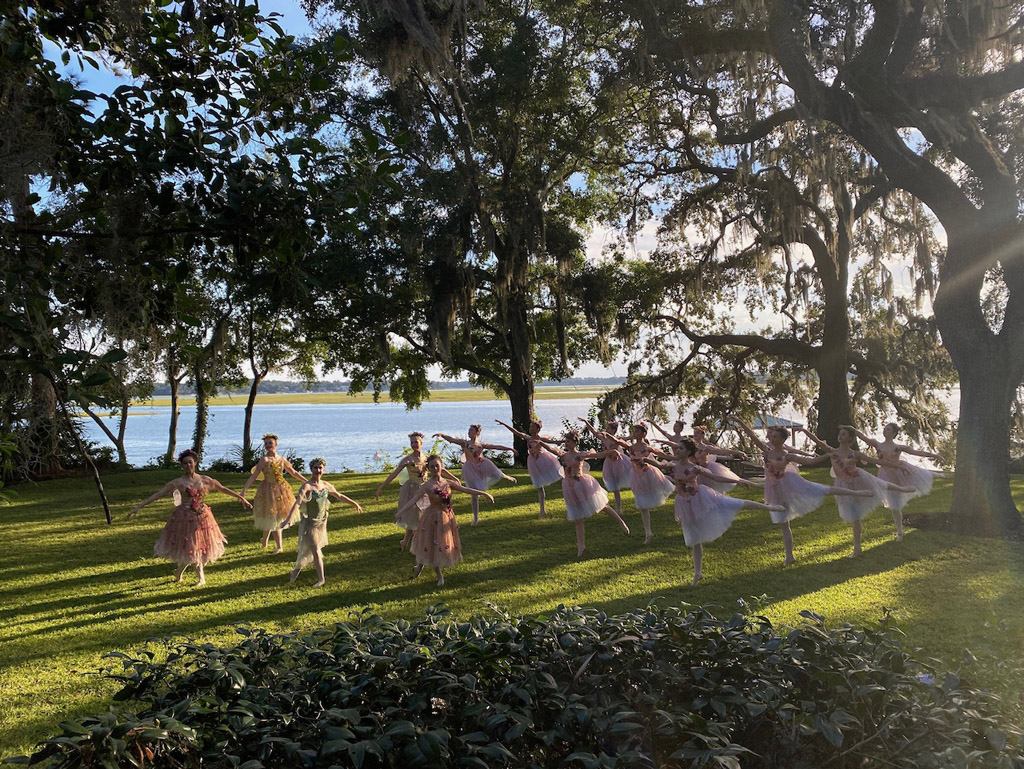
A scene from Plié on the May
Collaboration as Culture
Another reason for the organization’s staying power is that it has never operated in isolation. From the early partnership with the Community Playhouse to ongoing ties with the Arts Center, Hilton Head Symphony Orchestra, and other local arts groups, Hilton Head Dance School & Theatre has flourished as part of a wider cultural ecosystem.
Finger and Edwards participate in quarterly gatherings through the Town of Hilton Head Island’s Office of Cultural Affairs, in which representatives from numerous arts and cultural organizations share plans and explore ways to collaborate. The company also participates in Crescendo, Hilton Head’s fall celebration of the arts, and has become the final event in that month-long calendar. Those connections matter. They keep the organization visible, engaged, and woven into the larger life of the island.
There have also been more distinctive collaborations. One favorite is Plié on the May, a special event staged at a former board member’s home on the May River, where dancers perform outdoors against a breathtaking Lowcountry backdrop. Another is the company’s summer showcase collaboration with a Savannah school, giving dancers from both communities a chance to perform, learn, and support one another.
The organization also regularly brings in guest artists, especially for The Nutcracker and spring performances. Those guest artists not only elevate productions but also give students the rare chance to rehearse and partner with experienced professionals – an essential part of classical ballet training that smaller schools often cannot offer.
Milestones Worth Marking
Over 40 years, Hilton Head Dance School & Theatre has celebrated its milestones with intention: the 25th anniversary, the 30th, the 35th, and now the 40th anniversary season. The organization has marked those moments with galas, performances, and commemorative events, but the deeper milestone is less about a date than about endurance.
Few arts organizations thrive for four decades. Fewer still do so while maintaining such a high level of training, producing full-length classics, building an accomplished faculty, cultivating a nonprofit support structure, and retaining the loyalty of generations of families.
The growth has been practical as well as artistic. From 17 students in the first months, the school has grown to nearly 300 students. The theatre continues to present productions and develop dancers through its company and apprentice levels, while the school and academy sustain the pipeline of training.
What gives Hilton Head Dance School & Theatre its staying power?
Part of it is exceptional leadership. Part of it is artistic credibility. Part of it is a community that has shown up, bought tickets, volunteered, donated, and entrusted its children to the school for decades. But perhaps most of all, it is the consistency of the mission.
“To do something like this, it takes a community,” Finger said. And as Carlyle added, quality instruction, quality productions, and support all have to work together.
That is exactly what has happened here.
For 40 years, Hilton Head Dance School & Theatre has remained true to the art while also serving the people around it. It has trained dancers seriously, staged performances beautifully, collaborated generously, and helped shape generations of students into thoughtful, disciplined adults. In a transient world, that kind of continuity is rare. In the arts, it is even rarer.
But on Hilton Head Island, because of the vision of Karena Brock-Carlyle and John Carlyle, the stewardship of Lori Finger and the board, and the devotion of families who believed in what they built, that legacy continues – gracefully, powerfully, and still very much in motion.