


Just a short drive from Hilton Head and Bluffton is the quaint town of Port Royal, home to one of the most prolific rookeries for nesting birds in the Lowcountry. What started as a runoff retention pond in its downtown area has turned into an active mating habitat of thousands of birds and Lowcountry creatures each year.
The wetlands are managed through a partnership with the town of Port Royal and the nonprofit Friends of Port Royal Cypress Wetlands. Admission is free and open to the public during daylight hours. Visitors can expect about a half mile trail of pathways and boardwalks to explore this unique environment.
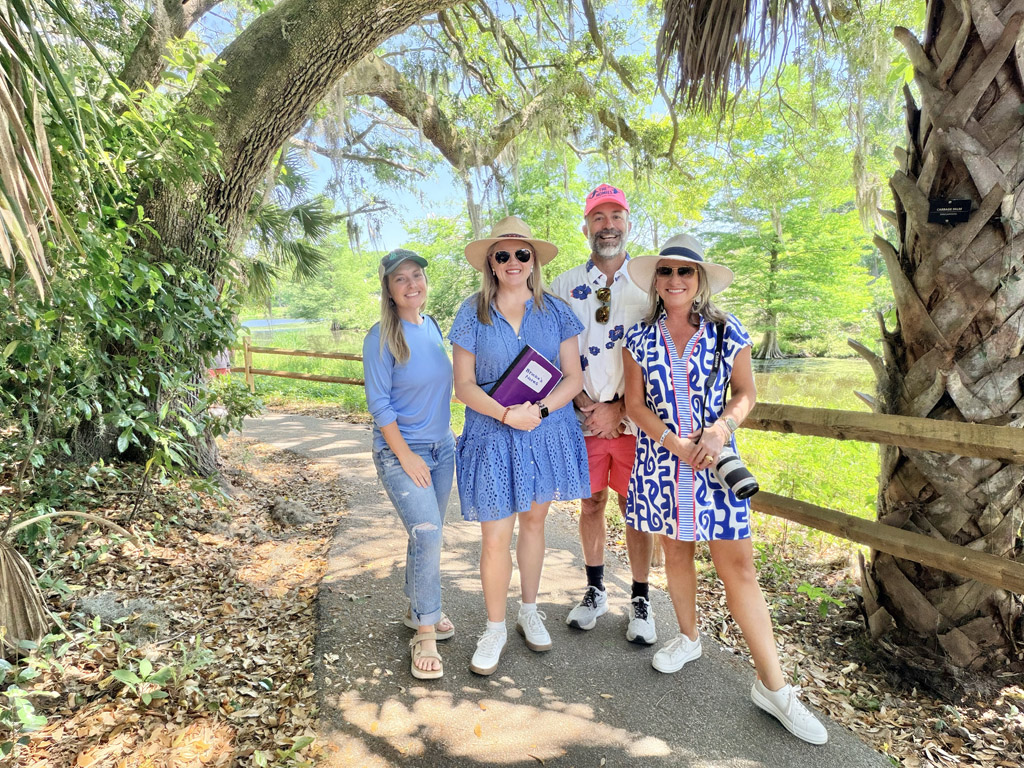
Mollie Kinard gives the CH2 crew a tour of the Cypress Wetlands. Educational outtings with Moore to Life, a concierge nature company, can also be scheduled at Hunting Island, Pinckney Island, Fish Haul Beach, and Botany Bay on Edisto Island.
During a mid-April visit, the CH2 crew of Maggie Washo, Jevon Daly, and I met up with Mollie Kinard and Jill Moore. Both women are master naturalists who help people discover our region’s wildlife, ecology, and landscapes through Moore to Life, a concierge nature company.
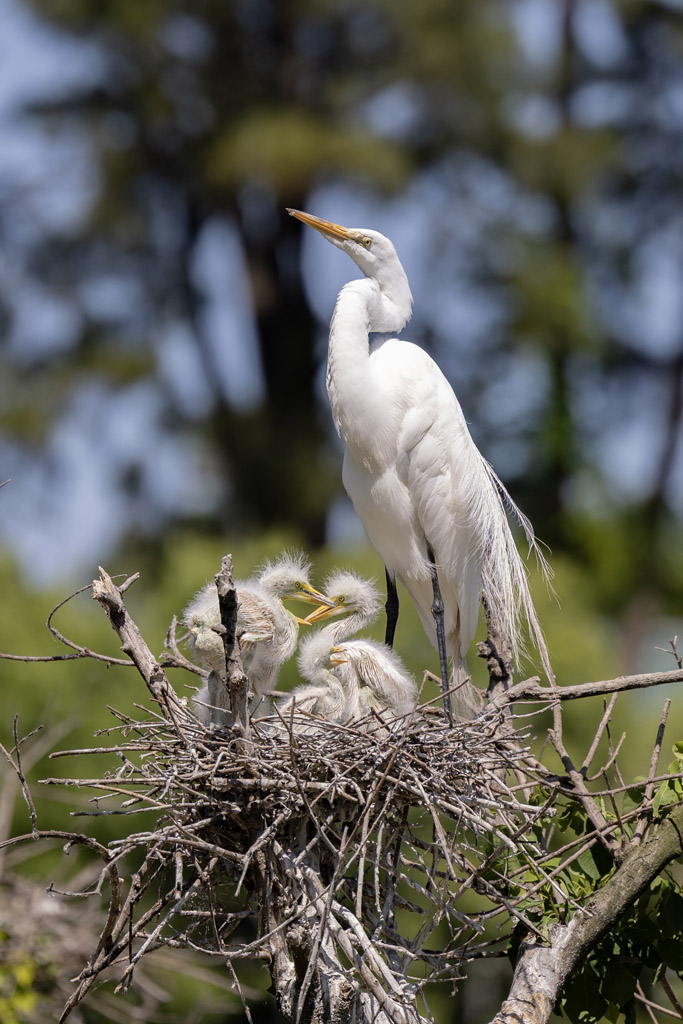
A Great Egret keeps a watchful eye over three new chicks.
Together, we explored the wetlands and learned why it’s a unique habitat full of plants and birds that all work together to survive and thrive. Springtime mating was on full display, with hundreds of birds on nests carefully watching eggs. We were excited to see that a few nests had already welcomed their babies.
As we entered the wetlands from Richmond Avenue, I was immediately blown away by its beauty. Tall, lush trees surrounded us and offered coolness in their shade. Bird voices were loud and constant.
Kinard shared that the forest is home to bald cypress trees, deciduous conifers that are green in the summertime but lose their needles in the winter, leaving them bald. “In November-ish, they’ll turn this really pretty orangey cinnamon color,” she said.

A curious alligator swims towards the shore.
A bald cypress trunk, the fluted buttress, is a wide, sturdy base that helps maintain its stability while surrounded by water. Its stubby “knees” look like tree stumps and are part of its root system.
As we peered at the forest, we quickly spotted our first birds, Black-crowned Night Herons, who make their nests in the shady forest on the edge of the wetlands. They are skilled hunters and most active after dusk, which draws them to the quiet forest for resting during the day.
When we emerged on the water’s edge, we watched birds that were constantly in flight as they worked to gather nest supplies and food, then stop to watch over their nests.
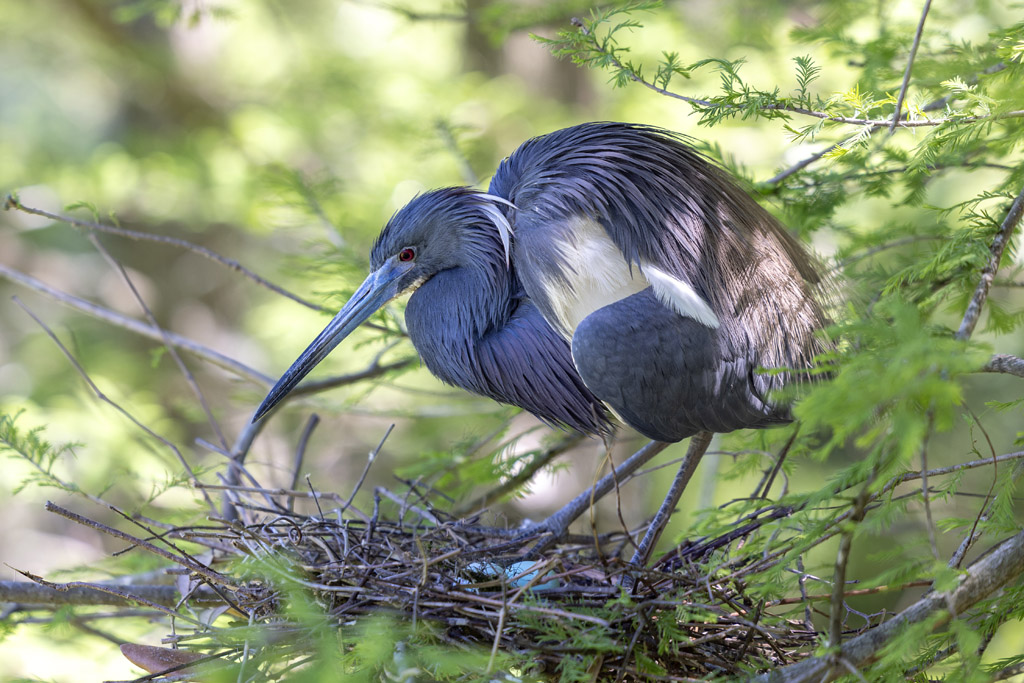
A Tri-colored Heron sits on small blue eggs.
We witnessed a flurry of wood storks, ducks, anhingas, egrets, and roseate spoonbills in close proximity. We learned that most of the bird varieties are non-migratory but some birds, including roseate spoonbills, are migratory and usually arrive in late spring and stay throughout the summer.
“We’re super proud of the fact that our wood storks, which just came off the endangered and protected list in February, had less than 10 nests a few years ago, and last year we had 75 nesting wood storks,” Kinard said.
The next bird to visit was the Yellow-crowned Night Heron, who was busy building a nest. “These birds spend the first few weeks at Home Depot getting sticks,” Moore said. “Then once the nest is built, they turn to Home Goods to get leaves and Spanish moss to make little pillows and comfort items.”
As we made our way out of the forest onto the boardwalk over the middle of the wetlands, the busyness of nature’s activity made it difficult to know where to look. Gators were swimming on both sides of us, birds were flying overhead, hundreds of bird parents were in their nests, and some baby birds were perched in nests.
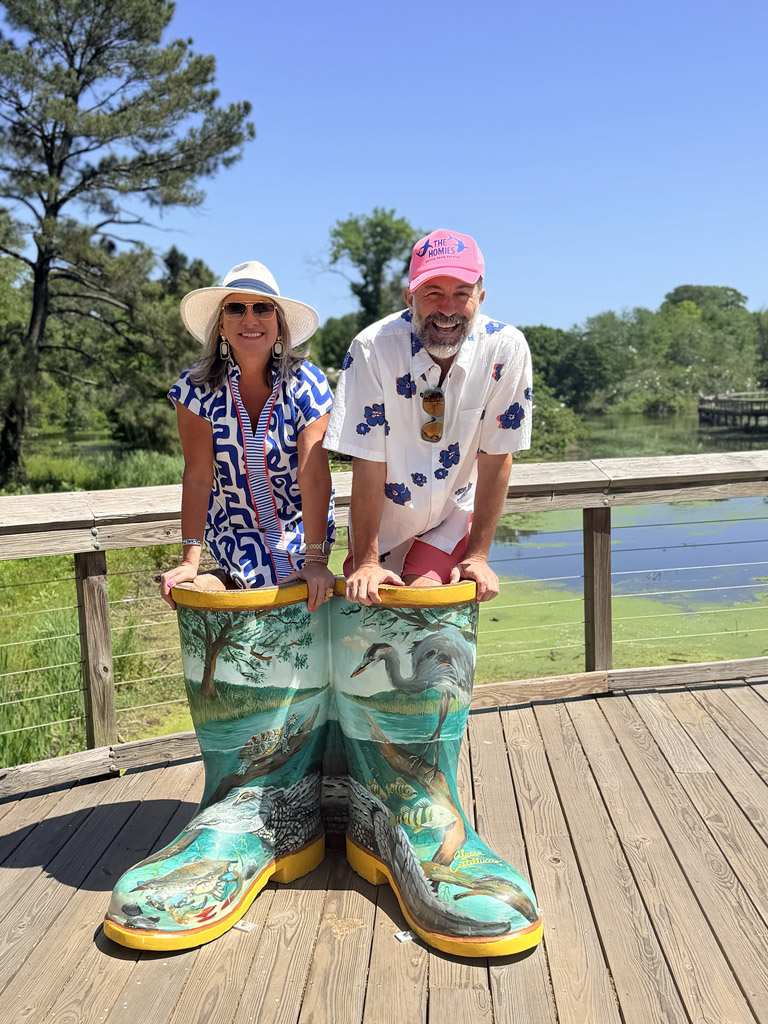
The Waterman’s Wave Lowcountry Boot Trail is an art installation that launched in January 2024, coinciding with the Beaufort Oyster Festival. These oversize boots have been creatively painted by local artists and can be found at various places throughout the area.
“The rookery involves all your senses,” Moore said. “You can hear things, see things, and you can definitely smell things.” We had experienced the first two senses in the forest but when we emerged over the water and got closer to the density of nests, the smell of pungent poo hit us very quickly. “It’s definitely a kind of fishy, insect odor to it,” Kinard said.
We spotted numerous gators of various sizes during our outing that help secure the rookery’s efforts. “They’re providing a kind of protection from things like snakes and raccoons to protect the nests,” Kinard said.
Bats also find their home in the wetlands. “We have a lot of little brown bats here,” Kinard said. “They really manage the mosquito and insect population. We always suggest to people, if you have bats around your yard, building bat houses is great because it keeps them out of your house and benefits the environment around you.”
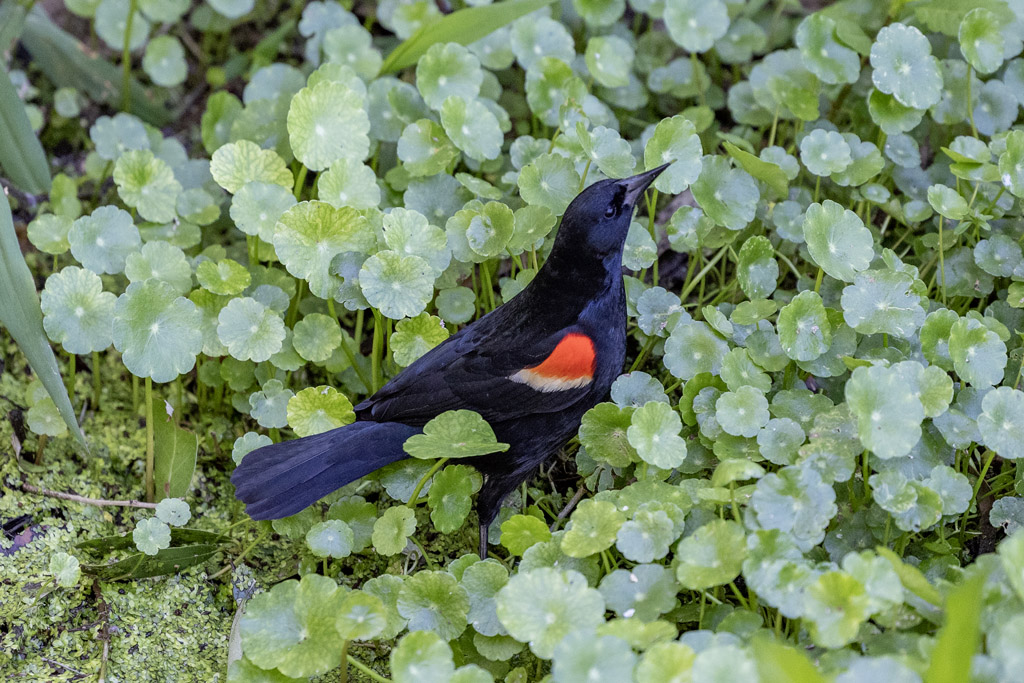
A male red-winged blackbird forages for insects.
In addition to wading birds and bats, we also spotted songbirds. Bird boxes are sprinkled around the wetlands for chickadees and bluebirds to make a safe home.
Between our guides’ master naturalist education and Daly’s self-taught knowledge, Washo and I were schooled about the flora in the wetlands. We sampled syrupy honeysuckles, which reminded me of my childhood. Moore pointed out elderberry flowers which both humans and birds use for their medicinal purposes. Daly broke up a wax myrtle leaf that can be used as a deterrent for bugs and Kinard pointed out wild poinsettias and bay leaves. We learned that yaupon holly leaves contain caffeine.
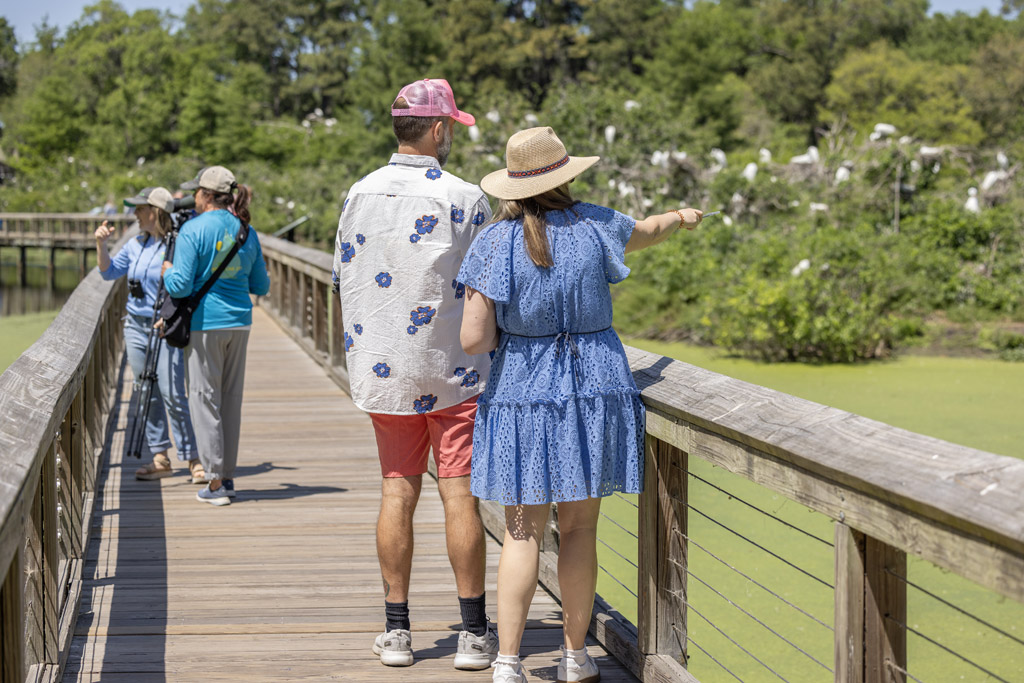
A large boardwalk offers a view from all vantage points, with hundreds of native birds tending to their nests.
Most people know the phrase “Leaves of three, let it be” to help avoid a poison ivy interaction. But Kinard gave us an extra warning about poison ivy vines. “It looks hairy, it has all these little tendrils coming off of it, which tells you it’s poison ivy,” she said. “That vine can be just as itchy as the leaves; it will have all the same oils. I do remind people if they are cutting poison ivy out of their yard, do not put it in a burn pile because you can get it in your lungs.”
Kinard showed us a large muscadine grape vine with lines of dots. “See all these little spots in a perfect line?” she asked. “This is one of those things that once you see it, you’ll never be able to unsee it. Those are holes made by a Yellow-bellied Sapsucker. They are woodpeckers that hang out here in the wintertime but always leave their mark before they go.”
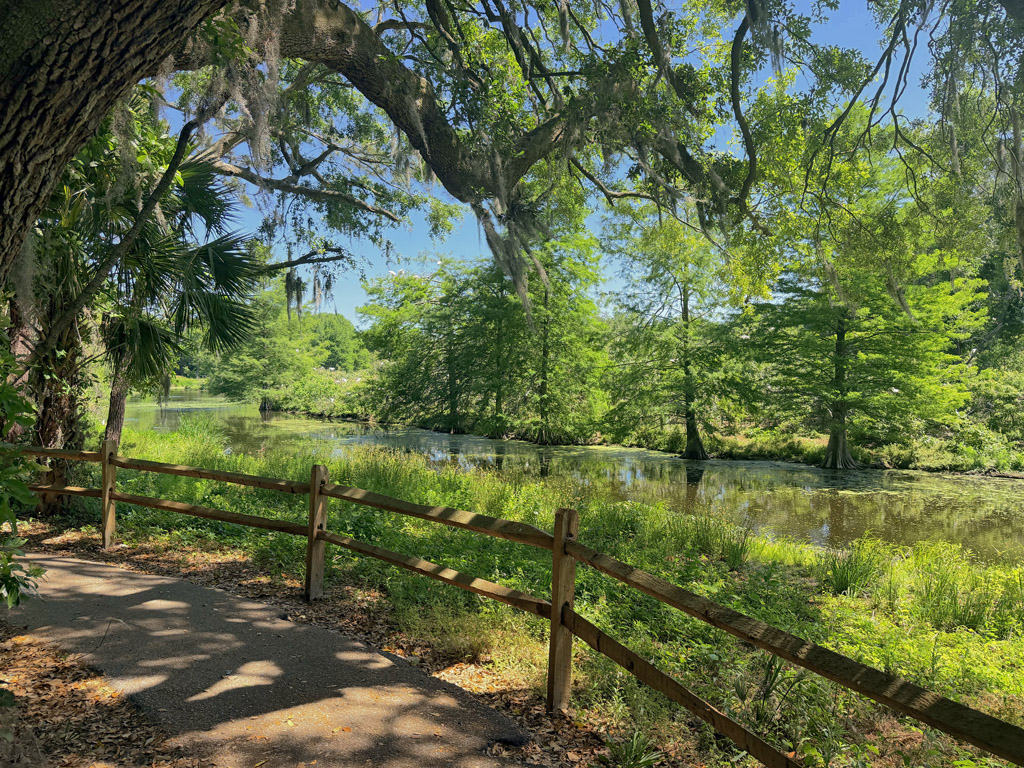
A shaded trail offers respite from the heat and a magnificent view.
Though we visited the wetlands in the spring, it remains an active habitat for visitors to enjoy in the summertime as well. “You’re going to have a lot of babies that were born in late April and early May start to be fledging, so you’ll see a lot more action,” Kinard said. “A lot of juveniles hang out around the outskirts trying to learn how to hunt and fish on the edges of the pond.”
The Port Royal Cypress Wetlands is just one of the many locations where Moore to Life offers concierge services. Educational outings can also be scheduled at Hunting Island, Pinckney Island, Fish Haul Beach, and Botany Bay on Edisto Island. Tours can be tailored to meet the needs of each group. Visit moore2lifesc.com for more information about all their tour offerings.
Visit friendsofportroyalcypresswetlands.org to learn more about the Port Royal Cypress Wetlands Preserve.
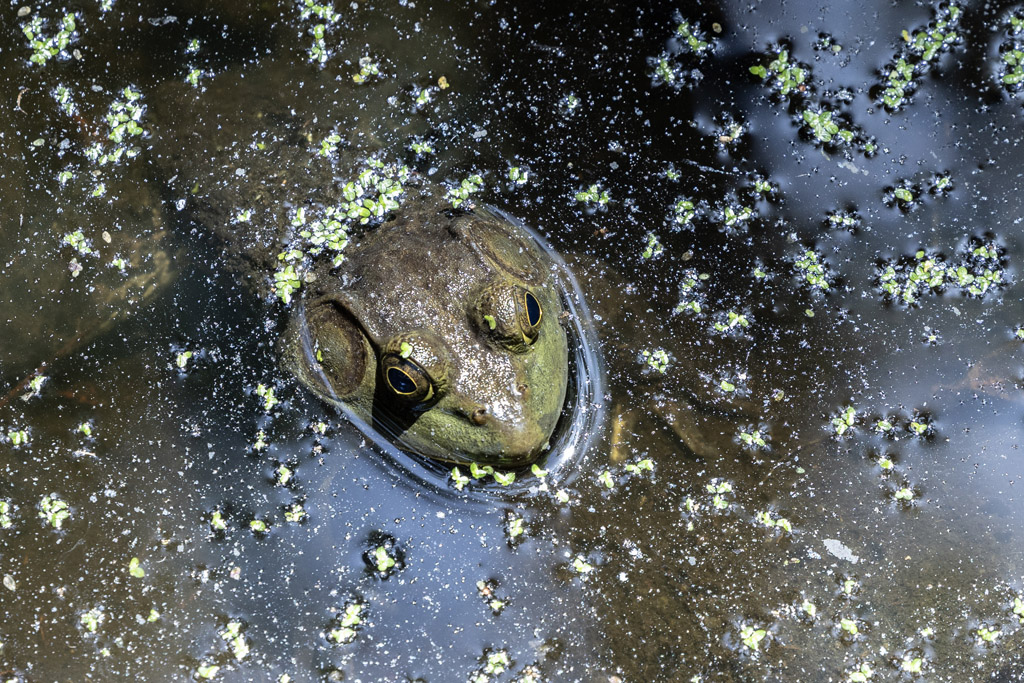
An American Bullfrog