


On any given Wednesday afternoon inside Needlepoint Junction on Hilton Head Island, a large communal table hums with quiet energy. Silk threads shimmer under soft light. Metallic fibers catch the sun. Someone laughs. Someone else leans in to ask about a stitch. It feels less like a store and more like a living room – one where generations gather, stories unfold, and something beautiful slowly takes shape.
Needlepoint, once dismissed as a pastime reserved for grandmothers and formal sitting rooms, is experiencing a vibrant resurgence. Across the country – and here in the Lowcountry – younger women, working professionals, creatives, and longtime stitchers alike are rediscovering the craft. At the center of the local revival is Michele Kay-Greene, owner of Needlepoint Junction since 2014.

Brandy and Kathy hard at work at the front desk of Needlepoint Junction.
“When I bought the store, I did not needlepoint,” Kay-Greene said. “I started a few years later, quietly, because I didn’t know what I was doing.”
The shop had already been a fixture on the island for more than 35 years. Kay-Greene inherited a loyal clientele – one that was understandably cautious. “They were very committed and very skeptical of me in the beginning,” she said. But while she didn’t yet stitch, she understood color and design. That instinct would become her bridge into the art form.

Michele Kay-Greene, owner of Needlepoint Junction since 2014, works on her own canvas at the Nanas and Needlepoint event, which happens monthly at the store. This event pairs experienced needlepointers with those new to the craft.
Her breakthrough came when she discovered decorative stitches. “It was like the lights went on,” she said. Decorative stitching goes beyond traditional basketweave or continental stitches. “When you step into decorative stitching, you’re really stepping into needle art.”
With silk, wool, and metallic fibers – sometimes separated into delicate plies and layered for dimension – a painted canvas transforms into something textured and alive. “You can create perspective,” Kay-Greene said. “You can make it look three-dimensional. You bring the canvas to life.”

Kay-Greene’s projects now range from florals and portraits to ornaments, pillows, ribbon-work boxes, and even a magnetic Advent calendar with interchangeable pieces. She doesn’t sell her work. “It’s too much of a labor of love,” she said. “It’s an heirloom in the making.”
The word “heirloom” carries weight. Unlike fast fashion or disposable décor, needlepoint requires intention. It demands hours, sometimes months. It becomes something stitched not just with fiber, but with memory. A finished stocking might hang on a mantle every year for decades. A framed piece might move from one generation to the next. The time invested becomes part of the value.
Yet for Kay-Greene, the stitching itself is only part of the story.

CH2’s Maggie Washo learns the technique from local needlepoint enthusiast Caitlin Lee.
“For me, it’s all about inclusivity,” she said. “We weave the canvas with thread, but what binds us is the stories that we tell at the table.”
Those stories might involve a Christmas stocking stitched to announce a new baby, a wedding gift in progress, or a canvas chosen because it reflects a grandchild’s favorite sport. The table becomes a place where milestones are shared organically. Engagements are celebrated. Grief is quietly supported. Laughter softens hard seasons.
“It’s not just the stitching,” Kay-Greene said. “It’s what the stitching can bring. It’s the community that it builds.”
Twice a week, Sit and Stitch gatherings welcome anyone who wants to pull up a chair. Larger retreats offer immersive weekends of creativity. Private groups reserve space to stitch together for birthdays, bridal weekends, or simply friendship. What might appear to outsiders as a solitary hobby becomes deeply communal inside the shop’s walls.

Susie Capen, an experienced seamstress and quilter, has recently taken up needlepoint. Pat Choban looks on, offering some tips.
A Modern Creative Outlet
Ashley Wilson, the shop’s manager, embodies that blend of artistry and accessibility. A former textile designer who studied at Savannah College of Art and Design, Wilson once worked with a 52-inch floor loom before discovering needlepoint as a portable alternative.
“I loved the look of needlepoint belts,” Wilson said. “I got my first kit, and I’ve not put it down since.”

Michele, Maggie and Caitlin consult on a project.
Wilson explains the craft in a way that demystifies it for beginners. “Needlepoint is like paint-by-number with threads,” she said. Unlike cross-stitch, where stitchers count spaces on blank fabric, needlepoint canvases are hand-painted. The stitcher interprets the design, selecting fibers and stitches to enhance it. “Each one of the canvases is hand-painted,” she said. Designers create the artwork; stitchers bring it to life.
Her own projects reflect needlepoint’s modern versatility. She recently completed what she calls a “spooky collage” canvas – 16 tiny Halloween-inspired squares – destined to become a pillow. She has also stitched a piece onto the back of a jean jacket for a friend. “That’s kind of fun too,” she said.
Needlepoint today isn’t confined to framed samplers. It appears on belts, handbags, hat bands, ornaments, pillows, even jackets. It bridges heritage with contemporary style.

Julie Lehr works on her canvas at the store.
The shop’s events further reflect this new energy. Pop-ups and trunk shows bring in designers whose collections fill the store for a month at a time. Sometimes the artists themselves visit, helping customers select threads for their own creations. “The designers are very hands-on,” Wilson said.
One of the most beloved initiatives is Nanas and Needles, designed to bridge generations. New stitchers can “adopt a nana” for a day, sitting beside experienced needleworkers to ask questions without pressure.
“It’s so incredible,” Wilson said, especially for those who move to the area without family nearby. “It really is a lifetime hobby. We have people that want to begin from ages 20 to 90.”
In a culture that often separates age groups, needlepoint gently unites them. A 30-year-old professional might sit beside an 80-year-old retiree, both working on different canvases yet connected by shared technique and conversation. Knowledge flows both ways – design ideas from one, lived wisdom from the other.

A Pandemic Pivot
Caitlin Lee represents that younger wave of stitchers fueling the revival. In her 30s, Lee is a third-generation needleworker. Her grandmother stitched. Her mother stitched. And during the pandemic, Lee rediscovered the craft in a new way.
“I work on the computer all day long,” she said. “I was moving from the big screen to the little screen and doom scrolling, and I wasn’t finding any joy in that.”
In 2020, she purchased projects from Needlepoint Junction during limited hours. By 2023, something clicked. “It started helping regulate my nervous system so much,” Lee said. As she launched her own business and navigated life transitions, needlepoint became a grounding ritual.
“The workday is done. Give your eyes and brain a break,” she said. “What are you going to do with your time?”

Geri helps CH2’s Jevon Daly thread his first canvas, which Caitlin Lee made for him to practice on.
For Lee, needlepoint also connects past and present. She has a cross-stitch sampler begun by her grandmother, later worked on by her mother, and eventually finished and framed for her home. It hangs as both artwork and inheritance.
Unlike Kay-Greene, who treasures heirlooms, Lee gravitates toward “durable goods” – keychains, hat bands, pieces she can use daily. She founded an after-hours stitch group called the “Martini Threads Stitching Society,” organizing beach gatherings and happy-hour meetups for working women who can’t attend daytime sessions.
“All through time, women have been getting together and collectively working on a similar project and sharing ideas,” she said. “This is just this generation’s moment.”

Brightly colored thread and canvases adorn Needlepoint Junction, located in the Village at Wexford.
Back at Needlepoint Junction, the rhythm of stitching continues. A beginner concentrates on her first canvas. A seasoned stitcher offers advice. Someone debates silk versus wool. Laughter ripples across the table.
Needlepoint’s revival isn’t loud or flashy. It’s steady. Intentional. Human.
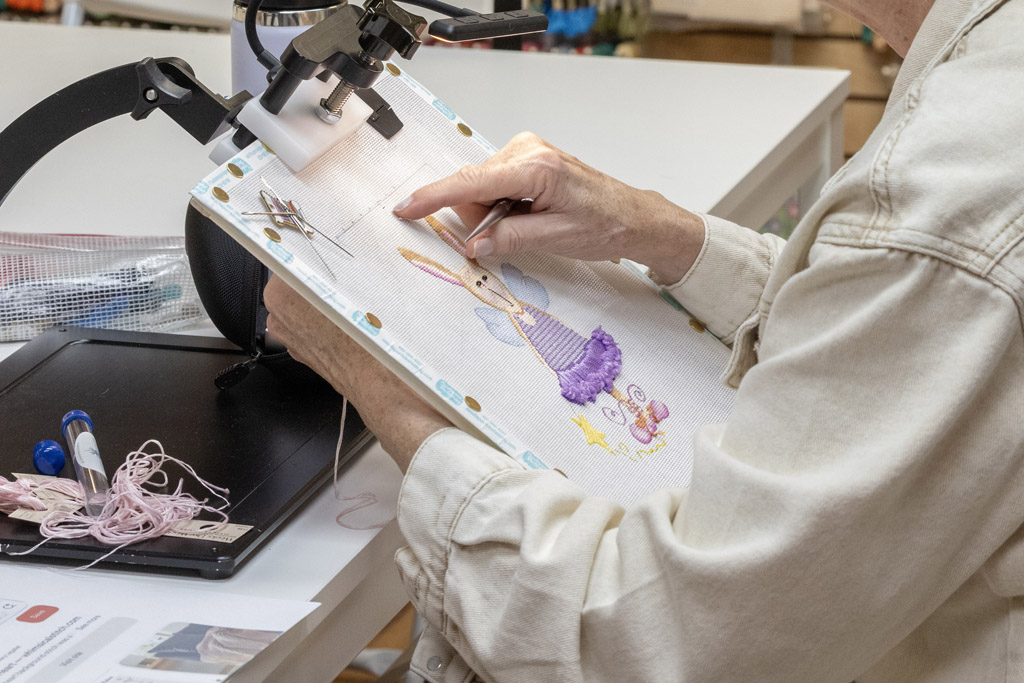
Maggie Ornduff works on a canvas that will become a pillow for her granddaughter.
In a world of instant downloads and overnight shipping, needlepoint insists on time. It asks for presence. It invites stillness. And in return, it offers something lasting – not just a finished piece, but a finished thought, a shared story, a calmer mind.
“Somebody may not move beyond a basic stitch and that’s okay,” Kay-Greene said. “It’s not our journey. It’s theirs.”
Thread by thread, story by story, the canvas grows. And in a fast-moving digital age, that simple act of slowing down, of gathering around a table and making something by hand, may be the most revolutionary stitch of all.