



Courtney’s Thoughts:
I’ll admit it – my initial reaction to the Artemis II mission was … skeptical.
The idea of “long-duration human presence” on the moon felt like a stretch, especially when the news broke amid a semi-government shutdown where TSA agents were working without pay and security lines stretched for hours. In that moment, it felt like maybe we should figure out air travel here on Earth before opening a terminal on the moon.
For context, space travel has never really enamored me. That might trace back to seventh grade, sitting in Mr. Gaskin’s class as we watched the Space Shuttle Challenger explode in real time. That sticks with you. Before that, my understanding of space came primarily from The Muppet Show’s Pigs in Space, which, frankly, set a high bar for storytelling.
Somewhere along the way, I missed the 2003 Columbia disaster entirely (still unclear how), but I can recite Armageddon word for word – the one where Bruce Willis and Ben Affleck save Earth by drilling into an asteroid. At one point, Steve Buscemi’s character points out they’re flying a machine with 270,000 parts “built by the lowest bidder,” which, if we’re being honest, doesn’t feel wildly disconnected from how some things still operate.
Which brings us to leadership.
Because if we’re being candid, NASA is led by a political appointee – not a scientist, not an engineer, but someone fluent in Washington. Necessary, perhaps. Comforting? Less so when the conversation involves rockets and the vacuum of space.
And yet.
The mission was named for Artemis – the Greek goddess of the moon, a fierce protector, a skilled archer, a woman. Paired with Orion, her hunting companion. A thoughtful nod, whether intentional or not.
But what struck me most over those ten days wasn’t the science. It was the people.
Four humans traveled farther than anyone in history, and what stood out wasn’t just what they were doing – it was how they showed up. With humor. With humility. With respect for the magnitude of the moment and the responsibility they carried.
They looked like us. Like the best version of us.
For a brief moment, the noise softened. The outrage cycle paused. And 240,000 miles away, a small group of people quietly reminded us what competence, collaboration, and actual leadership look like. (It helped that they also believe in science.)
Now that they’re safely home, I find myself less concerned about whether we can build a base on the moon – and more concerned about whether we can replicate that kind of leadership here on Earth.
Although, if any of them decide to run for office, I’d vote for them. Right after I make it through TSA.
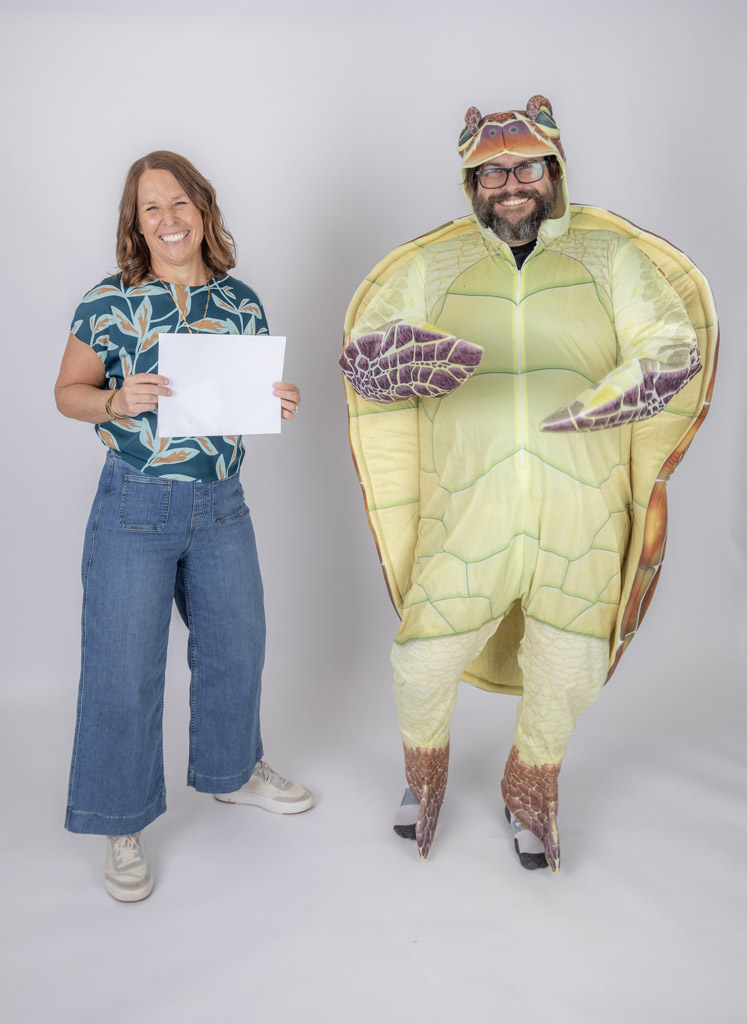
Barry’s Thoughts:
Before I begin, I’d like to take a moment and apologize to the readers of this magazine for the despicably foul language used by my counterpart in last month’s edition of “A Line in the Sand.” That kind of vulgarity has no place in polite society, and I am shocked and appalled that she got a swear word in print before I did. It’s a real kick in the ass.
And speaking of ass, let’s talk about the moon, shall we? (I should win a Pulitzer for that segue).
It’s in the news lately, as we recently sent a crew up on the Artemis mission to snap a few photos of the dark side of the moon and give us something to talk about for a few days. The reaction from most people was a resounding, “Huh, so that’s what it looks like. Anyway, back to Tik Tok-ing.”
Seriously, the biggest cultural moment of the whole thing came when people realized the “blue area” looks like a twerking Super Mario.
It’s a real testament to our short attention span as a culture. Remember when we used to go to the moon all the time? I wasn’t born yet, but it seems like we got really excited about Apollo 11. By Apollo 17, when they were just sending guys up there to golf or whatever, we were ready to go back to whatever people did in the ’70s instead of Tik Tok (I want to say cocaine).
It didn’t even take a bunch of missions this time. They went up, we watched it for a little bit, and then we forgot space existed all over again.
Folks, this isn’t about just putting people in space. It’s not even about establishing a base on the moon, even though that would be rad. It’s about doing the hard things, as Kennedy put it. To “measure the best of our energies and skills.”
We could use a little bit of that right now. Because our energies and skills are going to some really dumb uses. Do we need to advance AI so every commercial on TV can be as disturbingly fake as those Byrna ads? Do we need washing machines that can send emails?
Think of the actually useful things that have come out of us putting our skills to the test going into space. TempurPedic mattresses. The Bowflex. LED Lights. Astroglide brand personal lubricant. Each of those started out as a spark of innovation, with some NASA engineer trying to solve the problem of launching humans into the heavens.
The benefits of going into space have almost nothing to do with space itself. It’s always been about putting the smartest people in the country into the same room, challenging them to accomplish the impossible, and reaping the rewards of their brilliance when it’s put to good use. The fact that we get the occasional reminder of the universe’s grandeur – and some cool photos of rocks that look like twerking Mario – is just a bonus.